
The global demand for matcha powder has experienced unprecedented growth, transitioning from a specialty health beverage to a mainstream ingredient in the functional food, beverage, nutraceutical, and cosmetic industries. While historically associated with Japan, China has rapidly emerged as a dominant global force in high-quality matcha production. Thanks to vast tea-growing regions, advanced agricultural infrastructure, and competitive cost structures, China is now a key destination for global buyers seeking scalability and quality.
However, navigating the Chinese matcha supply chain requires deep technical knowledge. For B2B importers, distributors, and private label brands, selecting a supplier is not merely about comparing price per kilogram. It requires a rigorous assessment of agricultural practices, milling technologies, laboratory testing standards, and international compliance frameworks.
Partnering with an experienced, integrated matcha powder wholesale supplier who controls the supply chain from farm to factory is the single most effective way to mitigate risk, secure competitive pricing, and guarantee consistent product quality.
The global matcha market is expanding rapidly, driven by the clean-label movement, functional beverage trends, and the growing demand for natural sources of caffeine and L-theanine. While Japan remains famous for its traditional matcha culture, its high production costs, limited arable land, and vulnerability to localized weather events present sourcing challenges for high-volume buyers.
China’s strategic entry into high-quality matcha production has fundamentally altered the global sourcing equation. China’s primary tea-producing provinces, such as Zhejiang and Guizhou, feature ideal high-altitude, misty climates, and rich acidic soils perfectly suited for cultivating Camellia sinensis (the tea plant).
By leveraging massive agricultural economies of scale and investing in state-of-the-art Japanese-style processing lines, Chinese manufacturers provide several key sourcing advantages:
- Scalability and Volume Stability: Chinese plantations can yield thousands of tons of high-grade tencha annually, guaranteeing an uninterrupted supply chain even during peak global demand cycles.
- Cost Efficiency: Lower land and labor costs, combined with high-throughput processing facilities, translate to a pricing advantage of 30% to 50% over Japanese counterparts of equivalent grades.
- Comprehensive Customization: Chinese suppliers excel in OEM flexibility, offering tailored physical parameters (such as particle size and color metrics) and custom packaging solutions.
To capitalize on these advantages, B2B buyers must shift from transactional purchasing to a strategic sourcing model. This requires evaluating suppliers based on scientific metrics, chemical analyses, and certified quality management systems rather than relying solely on subjective marketing claims.
2. Understanding Agricultural Foundations: The 20-30 Day Shading Process and Amino Acid Synthesis
The quality of matcha is primarily determined in the field long before the tea leaves reach the processing facility. True matcha is distinguished from standard green tea powder by a highly specialized agricultural technique: canopy shading.

Approximately 20 to 30 days before the spring or summer harvest, the tea plantations are covered with overhead structures utilizing black vinyl netting or traditional straw mats. This shading structure is designed to block between 90% and 98% of direct solar radiation. This extreme reduction in sunlight triggers a profound botanical adaptation within the Camellia sinensis plants:
Chlorophyll Hyper-Accumulation
Sensing the light deficit, the tea leaves drastically increase their concentration of chlorophyll a and b to maximize photosynthetic efficiency. This biochemical shift results in the intense, vibrant green color characteristic of premium matcha. Unshaded or poorly shaded tea leaves remain a dull, brownish-yellow green due to lower overall chlorophyll density.
Amino Acid Preservation
L-theanine, an amino acid synthesized in the roots of the tea plant, naturally translocates to the leaves. Under direct sunlight, L-theanine undergoes UV-induced photolysis, converting into bitter catechins (polyphenols).
By blocking sunlight for 20 to 30 days, this conversion is suppressed, preserving high concentrations of L-theanine in the leaves. This high L-theanine content delivers the smooth “umami” flavor profile and sweet undertones prized in high-end matcha, while keeping astringent bitterness to a minimum.
Shading Durations and Sourcing Implications
When auditing a Chinese supplier, importers must inquire about the exact shading duration and materials used for each grade.
High-grade ceremonial offerings require a full 25 to 30 days of strict shading, whereas lower culinary or food-grade variations may only undergo 10 to 15 days of partial shading. A supplier’s failure to verify their shading protocols is a major red flag, suggesting that the product may simply be common unshaded green tea powder passed off as genuine matcha.
3. Industrial Processing Technology: Air Milling vs. Traditional Stone Grinding
Once the shaded leaves (tencha) are harvested, de-stemmed, de-veined, and dried, they must be milled into an ultra-fine powder. The milling technology chosen directly impacts the physical properties, nutritional density, and shelf-life of the final product.
Traditional Stone Grinding
This classic method utilizes rotating granite stone mills to slowly grind the tencha leaves. Due to the natural weight and grooves of the granite, the leaves are sheared rather than crushed. A single stone mill typically produces only 30 to 40 grams of matcha powder per hour.
The primary advantage of stone grinding is its exceptional temperature control. The slow rotation prevents heat buildup (keeping temperatures under 40°C), preserving the delicate volatile aromatic compounds and heat-sensitive chlorophyll.
Stone-ground matcha features an ultra-fine, uniform particle size (5 to 10 microns) and a unique spherical shape that allows the powder to suspend smoothly in water with minimal sedimentation.
Jet / Air Milling
To meet the high-volume requirements of industrial food manufacturing, food service, and large-scale private label brands, modern Chinese processors utilize advanced jet milling (or air milling) systems. This technology uses high-pressure, chilled air streams to cause tencha leaves to collide with one another at supersonic speeds, fracturing them into a fine powder.
While jet milling is highly efficient and capable of processing hundreds of kilograms per hour, it can generate significant friction heat if not properly regulated. High-quality Chinese factories mitigate this by using integrated liquid-nitrogen or chilled-air cooling jackets to maintain milling temperatures below 45°C.
Jet-milled matcha generally has a slightly larger, more angular particle size (12 to 25 microns) compared to stone-ground alternatives. It is highly suited for culinary applications, ready-to-drink (RTD) beverages, and nutritional supplements due to its excellent dispersibility and cost-efficiency.
4. Establishing Quality Benchmarks: Analyzing Color-Grading Parameters and Particle Size
To eliminate subjectivity during procurement, B2B buyers should establish clear, measurable quality benchmarks. Reliable suppliers must provide detailed technical specifications based on objective laboratory instrumentation rather than qualitative visual descriptions.
Colorimetric Parameters (CIE L*a*b* Color Space)
Using a spectrophotometer or colorimeter, the color profile of the dry matcha powder and its liquid suspension can be quantified. This system defines color using three coordinates:
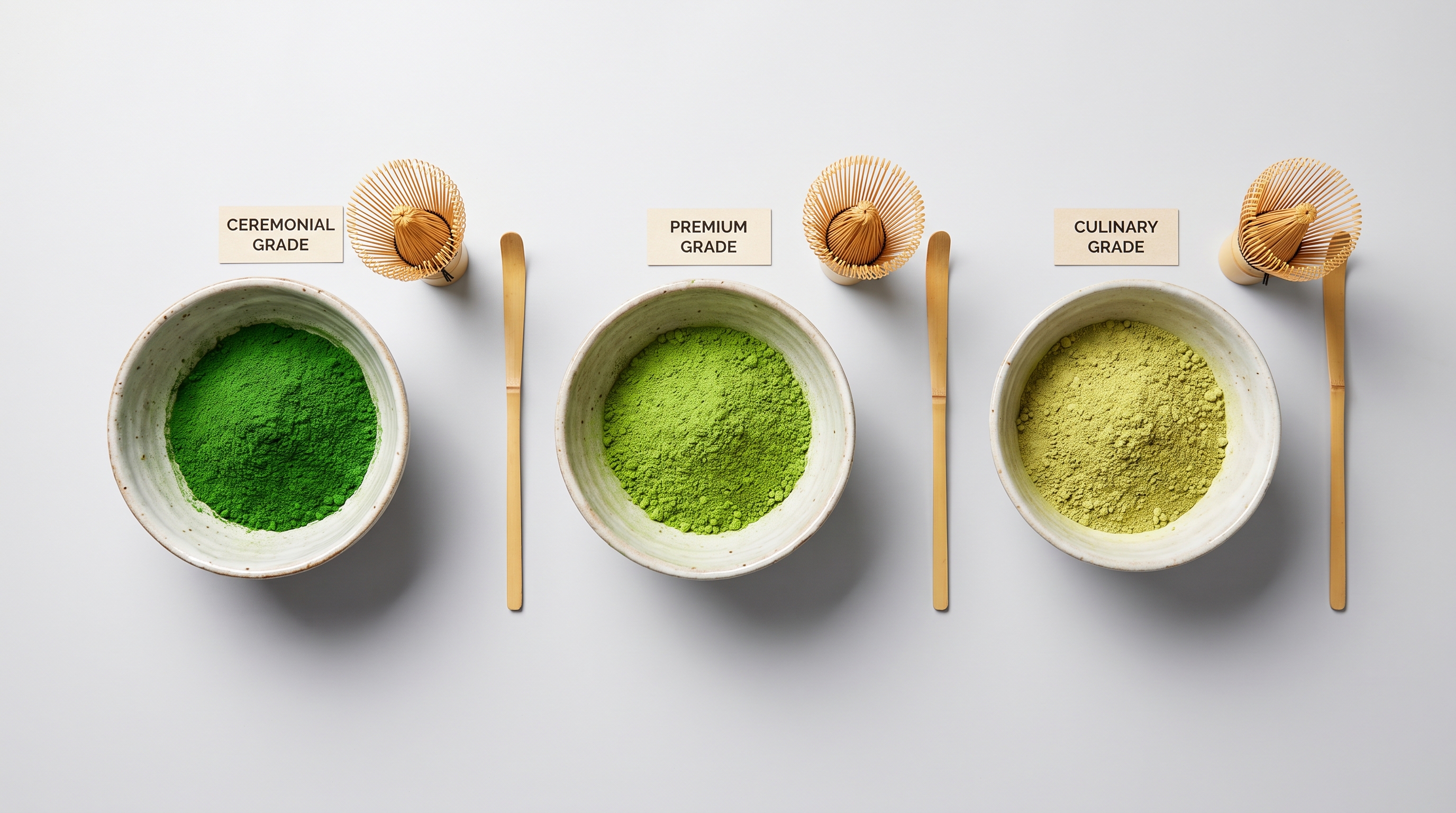
- L* (Lightness): Ranges from 0 (black) to 100 (pure white). High-grade matcha typically exhibits an L* value between 52 and 60, reflecting a bright, lively appearance.
- a* (Greenness-Redness): Negative values represent green, while positive values represent red. A more negative a* value indicates a deeper, more vibrant green. Premium ceremonial matcha should exhibit an a* value of -16.0 to -22.0. Culinary grades often fall between -10.0 and -14.0.
- b* (Yellowness-Blueness): Positive values indicate yellowness, while negative values indicate blueness. Premium matcha balances greenness with a subtle blue undertone (lower positive b* values), whereas low-quality matcha shifts toward yellowish-brown (higher positive b* values, exceeding +30.0).
Particle Size Distribution (PSD) via Laser Diffraction
The mouthfeel, solubility, and suspension stability of matcha are directly dictated by its particle size distribution, measured in microns (um).
- D50 (Median Particle Size): The diameter where 50% of the distribution is smaller. For high-grade drinking matcha, the D50 should ideally sit between 5.0um
and 12.0um.
- D90: The diameter where 90% of the distribution is smaller. To prevent a gritty mouthfeel in whisked applications, the D90 must remain below 25.0 um.
Analytical Biochemistry Metrics
A reliable manufacturer should also be able to verify chemical quality indicators through High-Performance Liquid Chromatography (HPLC):
- Total L-Theanine Content: Premium drinking grades should contain≥1.5%
L-theanine by dry weight.
- Chlorophyll Content: Excellent grades exceed 15 mg of total chlorophyll per gram of powder.
- Total Catechins: Higher in late-harvest culinary grades (providing a robust, bitter profile to cut through dairy and sweeteners) and lower in delicate spring-harvest ceremonial grades.
5. Distinguishing Genuine Factories from Trading Companies: Audit Frameworks
The Chinese export market contains many intermediate trading companies posing as direct manufacturers. While trading companies can offer consolidated shipping, they often add margins, lack direct control over agricultural practices, and struggle to guarantee batch-to-batch consistency. For long-term brand security and cost optimization, partnering with a direct, vertically integrated factory is highly advantageous.
The table below outlines a comparative audit checklist to help procurement officers distinguish direct manufacturers from middleman trading companies during the vetting process:
Audit Parameter | Direct Manufacturer (Integrated Factory) | Trading Company (Middleman) |
|---|---|---|
Tea Garden Control | Owns or holds long-term exclusive leases on tea plantations; provides full agricultural records from soil to harvest. | Sours raw leaves or finished powders from various regional markets; cannot trace back to specific plots. |
Production Transparency | Welcomes physical and live video audits of primary processing, drying, and milling facilities. | Reluctant to show production lines; often suggests “subcontracted” facilities with restricted access. |
OEM & Custom Packaging | Features in-house cleanrooms with automated packaging lines (stick packs, tins, bags) and strict environmental controls. | Relies on third-party co-packers, increasing the risk of microbiological contamination and lead times. |
Cost Structure | High transparency; offers volume-based pricing tied to raw material indexes and direct manufacturing costs. | Opaque pricing with hidden markups; struggles to maintain stable prices during market fluctuations. |
Traceability Protocols | Fully integrated batch numbers linking final packages to specific harvest dates, processing lines, and field blocks. | Fractional or generic batch numbering; lacks chronological agricultural data. |
Technical QA Support | In-house laboratory capable of testing moisture, particle size, color indices, and basic micro-parameters. | Relies solely on external, manufacturer-provided COAs; lacks technical personnel to resolve quality deviations. |
6. Technical Specifications of Matcha Grades: Comparative Analysis
Matcha is not a uniform product; it is classified into distinct tiers based on harvest timing, leaf position on the stem, shading duration, and processing technology. Choosing the correct grade is essential for aligning product performance with consumer expectations and target margins.
The table below details the technical specifications of the three primary commercial matcha tiers:
Parameter | Premium Beverage Grade | ||
|---|---|---|---|
Harvest Timing | First Flush (Early Spring) | Mid-Spring / Second Flush | Summer / Autumn Harvest |
Leaf Position | Top 2 tender leaves of the shoot | Middle leaves of the plant | Lower, mature leaves |
Shading Duration | 25 to 30 days (Strict) | 20 to 22 days | 10 to 15 days (or partial shade) |
Milling Method | Granite Stone Ground | Ultra-Fine Jet milled / Stone Ground | High-Capacity Jet milled |
Color Coordinates (CIE a*) | -18.0 to -23.0 (Vibrant Emerald) | -14.0 to -17.9 (Bright Jade) | -8.0 to -13.9 (Olive to Yellow-Green) |
Median Particle Size (D50) | 5.0 μm\mu\text{m} to 10.0 μm\mu\text{m} | 10.0 μm\mu\text{m} to 15.0 μm\mu\text{m} | 15.0 μm\mu\text{m} to 25.0 μm\mu\text{m} |
L-Theanine Content | ≥2.0%\ge 2.0\% | 1.0% to 1.9% | < 0.8% |
Taste Profile | Intensely sweet, rich umami, virtually zero bitterness or astringency | Balanced sweetness with subtle astringency, creamy finish | Bold, robust vegetal taste, distinct bitterness, high astringency |
Primary Applications | Traditional whisking, premium RTD lattes, high-end wellness supplements | Commercial cafés, matcha lattes, ice creams, active lifestyle protein blends | Industrial baking, confectionery, food processing, blending |
Understanding these distinctions helps importers match the correct grade to their specific product application, avoiding overpaying for high-end ceremonial powders in industrial applications where a robust culinary grade is better suited to cut through dairy or sugar.
7. Rigorous Food Safety Standards: Heavy Metals, Pesticide Residues, and Microbiological Controls
Because matcha is consumed as a whole leaf suspended in liquid rather than an infusion, its chemical purity is paramount. This makes food safety the single most critical risk-management focus in matcha procurement.
Reputable Chinese manufacturers maintain high-standard laboratory testing protocols to guarantee compliance with international food regulations.
Heavy Metal Mitigation
Tea plants (Camellia sinensis) are hyper-accumulators of elements from the soil. Lead contamination, historically a concern in Chinese agriculture, must be strictly managed. Leading manufacturers source leaves exclusively from high-altitude, clean-air tea gardens far removed from industrial hubs. Every batch of imported matcha should comply with stringent international safety thresholds:
- Lead (Pb):
≤1.0ppm(or lower, to comply with strict regional limits such as California Proposition 65 thresholds of
<0.5mcg daily intake).
- Arsenic (As):
≤0.5ppm.
- Cadmium (Cd):≤0.2ppm.
.
- Mercury (Hg):≤0.1ppm.
Pesticide Residue Testing
For both conventional and organic matcha, compliance with the pesticide Maximum Residue Limits (MRLs) set by the US EPA and European Food Safety Authority (EFSA) is non-negotiable.
Importers should require complete Multi-Residue Screenings covering over 500 pesticide compounds, conducted via gas chromatography-tandem mass spectrometry (GC-MS/MS) and liquid chromatography-tandem mass spectrometry (LC-MS/MS).
For the European market, organic matcha must show complete absence of prohibited substances down to the Limit of Quantification (LOQ) of 0.01 mg/kg.
Microbiological Standards & Pasteurization
Matcha is a raw agricultural product processed at low temperatures, making it susceptible to microbial growth if not handled correctly. To protect your brand from recalls, ensure your supplier’s quality control aligns with the following limits:
- Total Plate Count (TPC):≤10000CFU/g.
(Premium factories often achieve<1000CFU/g
using advanced steam sterilization).
- Yeast and Mold:<100CFU/g
.
- Coliforms: Negative.
- E. coli & Salmonella: Negative in 25g.
To safely reduce microbiological loads in culinary and beverage grades without destroying the delicate color and aroma, suppliers should use High-Temperature Short-Time (HTST) steam pasteurization systems. This technology deactivates bacteria in seconds while preserving the product’s sensory qualities.
8. Navigating International Compliance: FDA, EU, and Organic Certifications
Exporting agricultural products from China to Western markets requires navigating a complex web of certifications and documentation. Without proper compliance paperwork, shipments risk customs delays, seizure, or destruction at the port of entry.
Key Food Safety Certifications
Your chosen supplier’s manufacturing facilities should be certified by a recognized Global Food Safety Initiative (GFSI) standard. Look for the following certifications:
- FSSC 22000 / ISO 22000: Confirms a robust food safety management system covering the entire processing cycle.
- HACCP (Hazard Analysis Critical Control Point): Ensures systematic monitoring of physical, chemical, and biological hazards at critical steps.
- FDA Facility Registration: Mandatory for any supplier exporting to the United States.
Organic Certification Credibility
To label your product as organic in the United States or Europe, the entire supply chain—from the Chinese farm to your retail packaging—must be certified organic by accredited bodies.
- USDA NOP (National Organic Program) & EU Organic: These certifications require annual, unannounced physical inspections of the tea plantations and processing facilities.
- Transaction Certificates (TCs): Every organic shipment must be accompanied by a valid Transaction Certificate issued by an accredited certifier (such as Kiwa BCS, CERES, or Ecocert). The TC serves as the official link proving that the specific batch shipped matches the certified organic land allotment.
Importers must perform due diligence by verifying the certifier’s database to ensure the supplier’s organic certificate is active, lists the correct facility address, and covers the exact product name being imported.
9. Verifying Factory Operations: Conducting Physical and Virtual Audits
While paper certifications provide a baseline of security, the industry’s most reliable brands conduct direct facility audits. If a physical trip to China is not feasible due to travel budgets or scheduling constraints, a structured virtual audit via high-definition live video is a highly effective alternative.

During a physical or virtual tour of the processing facility, focus your evaluation on these critical operational zones:
Personnel Hygiene and Cleanroom Entry
The packaging and final blending rooms must operate as positive-pressure cleanrooms (ideally Class 100,000/ISO 8 or better).
Look for double-door airlocks, mandatory shoe changes, complete hairnets, face masks, beard covers, and protective suits. Hand sanitation stations must be sensor-activated with medical-grade sanitizers.
Air Filtration and Temperature Regulation
The processing, grinding, and blending rooms must be climate-controlled. Excess heat and humidity accelerate the oxidation of matcha powder, turning it yellow and degrading its nutritional value.
Ask the factory manager to display the real-time temperature and relative humidity (RH) indicators in the grinding room; temperatures should ideally remain below 22°C with an RH under 50%.
Foreign Matter and Contamination Prevention
Modern factories should employ a multi-stage foreign object detection system:
- Strong Rare-Earth Magnets: Installed along the gravity-feed lines to capture any fine ferrous metal particles generated during milling.
- Vibrating Sifters: Fitted with ultra-fine mesh screens to filter out any clumped particles or foreign materials.
- Integrated Metal Detectors: Positioned after final packaging to scan finished pouches or boxes. The detector should be calibrated to identify ferrous, non-ferrous, and stainless steel contaminants down to sub-millimeter tolerances.
10. Private Label and OEM Customization: Packaging Types, MOQs, and Lead Times
For e-commerce brands, retailers, and functional food startups, launching a private label matcha product line requires a manufacturing partner with strong packaging capabilities and flexible Minimum Order Quantities (MOQs).
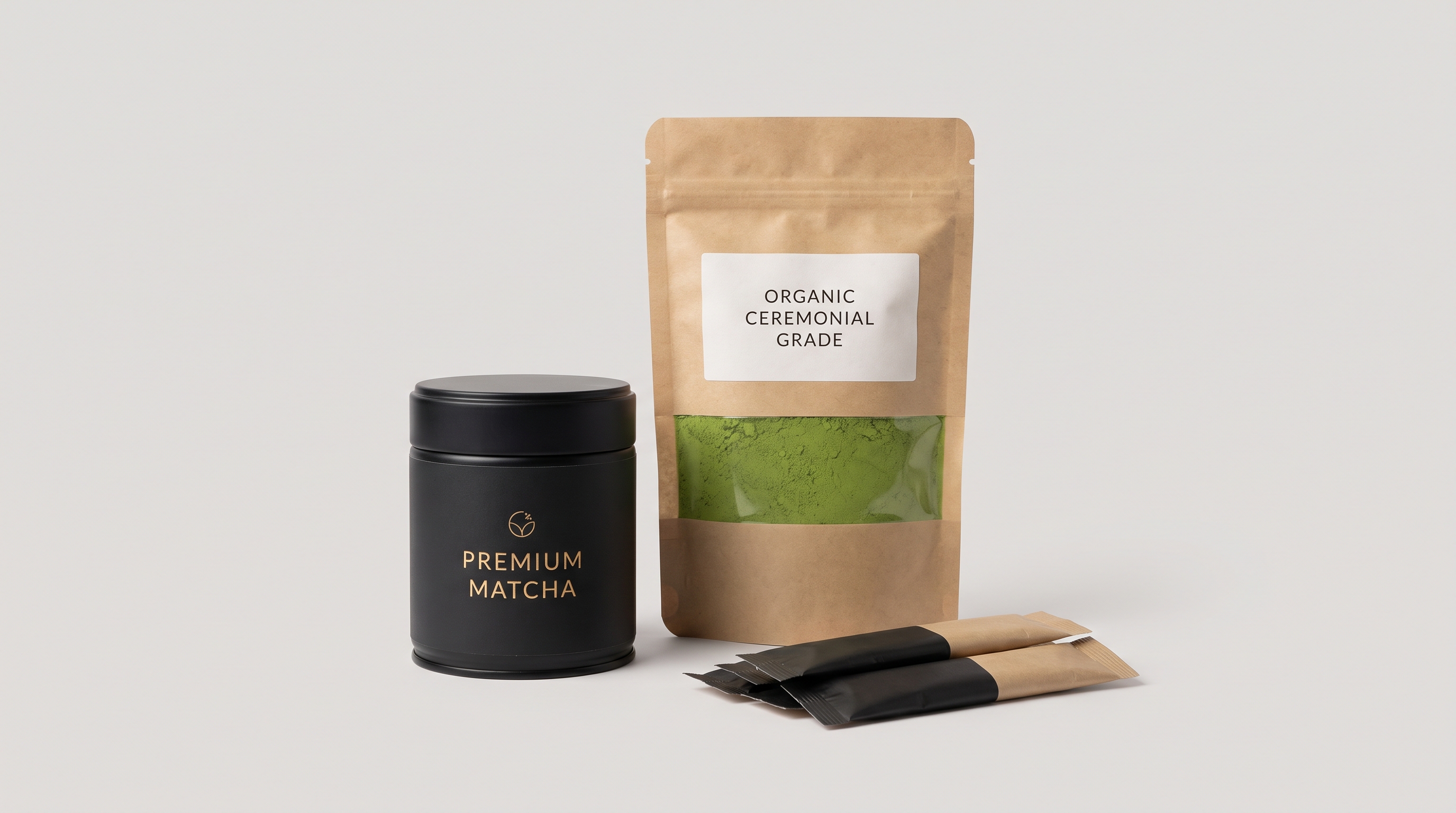
The table below outlines the primary OEM packaging formats, their typical MOQs, and production lead times to help you plan your product launch:
Packaging Type | Target Market / Position | Standard Size Range | Packaging MOQ Range | Typical Production Lead Time | Key Sourcing Considerations |
|---|---|---|---|---|---|
Aluminum Foil Stand-Up Pouches | Mass-market retail, e-commerce, café back-of-house | 30g, 50g, 100g, 250g, 500g, 1kg | 5,000 to 10,000 units (for custom gravure print); 500+ units (for digital print/stickers) | 25 to 30 days (first print run) | High oxygen and moisture barrier is essential; multi-layer metallized structure (PET/AL/PE) is highly recommended. |
Metal Tins (Seamless Steel/Aluminum) | Premium Ceremonial Grade, gift sets, organic retail | 30g, 40g, 80g | 5,000 to 10,000 units (direct print); 1,000+ units (with premium adhesive labels) | 30 to 35 days | Must include an inner pull-ring foil seal to lock in freshness; food-grade internal lacquer is required. |
Single-Serve Stick Packs (Sachets) | Grab-and-go retail, convenience stores, lifestyle lattes | 1.0g, 1.5g, 2.0g, 3.0g | 50,000 to 100,000 individual sticks | 35 to 40 days | Requires high-speed vertical form-fill-seal (VFFS) machinery with precise volumetric dosing and integrated nitrogen-flushing. |
Bulk Kraft Bags (Foil Lined) | Industrial food processors, bakeries, large distributors | 5kg, 10kg, 20kg, 25kg | 100 kg to 500 kg (per grade) | 10 to 15 days | Packaged in double-walled food-grade PE bags placed inside durable outer fiber cartons. |
When selecting a private label partner, prioritize manufacturers who offer in-house packaging and design support. This integration streamlines the supply chain, reduces handling risks, and lowers overall freight costs compared to using separate third-party co-packers.
11. Logistics, Cold Chain Management, and Shelf-Life Preservation
Matcha is highly sensitive to the environment. When exposed to light, heat, moisture, or oxygen, its delicate chlorophyll molecules degrade into brown pheophytin, the sweet L-theanine oxidizes into bitter compounds, and the delicate green tea aroma fades.
Securing a premium product from a Chinese factory is only half the battle; preserving that quality across thousands of miles of transit requires strict logistical protocols.
Vacuum Sealing and Nitrogen Flushing
Before sealing any retail or bulk packaging, top-tier factories utilize integrated nitrogen-flushing technology. By injecting high-purity nitrogen gas into the packaging, ambient oxygen levels are reduced to less than 1%.
For bulk packaging, vacuum sealing combined with food-grade oxygen scavengers (such as iron-powder-based oxygen absorbers) is crucial for halting any degradation during storage and transit.
Temperature-Controlled Logistics (Cold Chain)
For long-distance ocean shipping from Chinese ports (such as Ningbo, Shanghai, or Qingdao) to North America or Europe, temperature control is essential.
Standard shipping containers can experience internal temperatures exceeding 50°C when crossing equatorial shipping lanes. Exposure to this extreme heat will degrade high-grade ceremonial matcha, turning it dull and bitter before it arrives at your warehouse.
- Reefer Containers: Importers sourcing premium ceremonial or high-grade beverage matcha should utilize refrigerated (Reefer) ocean containers set to maintain a constant temperature between 2°C and 8°C.
- Insulated Thermal Blankets: For smaller shipments or mid-grade culinary varieties, using insulated container liners or thermal blankets can help buffer against major temperature spikes during transit.
Destination Warehousing
Upon arrival, matcha should be stored in a dark, dry, climate-controlled warehouse. Keeping temperatures below 20°C (ideally under refrigerated storage at 2–8°C for delicate grades) and relative humidity below 45% ensures the product retains its vibrant color, fresh aroma, and smooth flavor profile throughout its standard 18 to 24-month shelf life.
12. Frequently Asked Questions (FAQ) for B2B Matcha Importers
Q1: What are the typical Minimum Order Quantities (MOQs) for bulk vs. private label matcha?
For bulk matcha shipments packaged in standard 10kg or 25kg double-walled foil bags inside cartons, the MOQ typically ranges between 100 kg and 200 kg per grade.
For fully customized private label (OEM) projects featuring custom-printed pouches or tins, the MOQs are tied to the packaging manufacturer’s minimum print runs. This usually requires 5,000 to 10,000 units per SKU. However, digitally printed pouches or adhesive-labeled packaging can often be sourced with a lower entry MOQ of 500 to 1,000 units.
Q2: What is the standard shelf life of bulk matcha, and how should it be stored?
Under optimal storage conditions, bulk matcha has a shelf life of 18 to 24 months from the manufacturing date. Once a bulk package is opened, it should be resealed tightly and consumed within 2 to 3 months to prevent quality loss.
To maintain maximum freshness throughout its shelf life, keep the powder stored in airtight, light-blocking packaging at a stable temperature of 2°C to 8°C with relative humidity below 45%.
Q3: Is cold chain shipping mandatory for importing matcha from China?
Cold chain shipping is highly recommended for high-grade drinking and ceremonial matcha, particularly during the hot summer months. Standard shipping containers crossing equatorial lanes can reach temperatures that degrade the chlorophyll and aromatics of premium tea.
While lower-cost culinary grades are more heat-tolerant and can be shipped in standard containers with thermal insulation blankets, high-end ceremonial grades should always be shipped via refrigerated containers (Reefers) to preserve their premium quality.
Q4: How can we request custom samples, and what is the testing process?
Professional B2B buyers can request custom samples by contacting our sales team. We typically supply 50g to 100g sample sizes of various grades for sensory evaluation, solubility testing, and in-house laboratory analysis.
We recommend requesting samples from the exact production batch that will be allocated to your order. Once received, evaluate the samples for dry color vibrancy, whisability, sediment suspension, aroma profile, and bitterness level under standard beverage preparation protocols.
Q5: How do we verify the authentic USDA and EU organic status of a Chinese supplier?
Authentic organic status can be verified by requesting the supplier’s current organic certificates issued by accredited certification bodies (such as Kiwa BCS, CERES, or Ecocert).
Ensure the business name and facility address listed on the certificate match the supplier’s business license. Furthermore, verify that every commercial shipment is accompanied by a valid Transaction Certificate (TC) issued specifically for your order, showing the exact batch numbers and volume of organic product exported.
Secure Your Global Matcha Supply Chain with Riching Matcha
Sourcing premium, consistent, and fully compliant organic matcha requires a manufacturing partner who controls the entire supply chain.
As a vertically integrated, certified organic matcha powder wholesale supplier in China, Riching Matcha is a trusted manufacturing partner for leading importers, distributors, and global superfood brands.
Why Leading Global Brands Partner with Riching Matcha:
- Direct Factory Integration: We operate our own 4,000,000 ㎡ USDA and EU certified organic tea plantations. This gives us direct control over agricultural practices, shading protocols (20–30 days), and raw material traceability.
- State-of-the-Art Processing: Our manufacturing facilities operate under strict FSSC 22000, ISO 22000, and HACCP systems. We utilize advanced, low-temperature jet milling and traditional stone grinding to produce uniform particle sizes with excellent color preservation.
- Turnkey Private Label (OEM) Services: From custom blending to packaging solutions (including nitrogen-flushed stick packs, aluminum tins, and stand-up pouches), we manage your complete private label production from design to final container loading.
- Uncompromised Quality Control: Every production batch undergoes strict testing for heavy metals, microbiological safety, and multi-residue pesticide screenings at independent, ISO-accredited testing laboratories (such as SGS and Eurofins).
Whether you need bulk premium ceremonial powder for drinking or robust culinary matcha for large-scale food manufacturing, Riching Matcha delivers stable volume, competitive pricing, and reliable quality.
Ready to optimize your matcha sourcing? Please contact us today to discuss your technical specifications, request custom samples, or receive a direct factory quote.