
The global matcha market has transitioned from a niche ceremonial beverage to a multi-billion dollar industrial staple. For procurement officers, beverage brand owners, and health-supplement manufacturers, the challenge is no longer finding matcha, but securing a supply chain that balances cost-efficiency with uncompromising quality. This comprehensive guide provides a strategic blueprint for navigating the complexities of bulk matcha acquisition, ensuring your business scales with a product that meets both consumer expectations and international regulatory standards.
In the competitive landscape of “better-for-you” products, matcha offers a unique value proposition. Unlike standard green tea, matcha is a suspension of the entire leaf, providing ten times the nutritional density. For businesses, buying in bulk is not merely about reducing the price per kilogram; it is about securing long-term consistency and supply chain resilience.
When you partner with a direct manufacturer like Riching Matcha, you bypass the “middleman markup” typical of domestic distributors. This direct-to-source model allows for:
- Customized Specifications: Tailoring the amino acid profile or particle size to specific product applications (e.g., ready-to-drink lattes vs. encapsulated supplements).
- Inventory Stability: High-volume buyers can lock in annual contracts, protecting against price volatility caused by harvest fluctuations.
- Direct Quality Control: Access to the original Certificates of Analysis (COA) and the ability to audit the production facility.
Strategic sourcing shifts the focus from “price-hunting” to “value-building,” allowing your brand to promise—and deliver—a consistent sensory experience. As a trusted source for bulk matcha wholesale , manufacturers must demonstrate deep control over their botanical assets.
2. Decoding Matcha Grades: From Ceremonial to Culinary
One of the most significant pitfalls for bulk buyers is the lack of standardized nomenclature. Terms like “AAA Grade” or “Imperial” are marketing constructs. To make informed decisions, businesses must categorize matcha by its harvest timing and sensory profile. Understanding the different grades of organic matcha is essential for COGS optimization.
H3: The Harvest Hierarchy
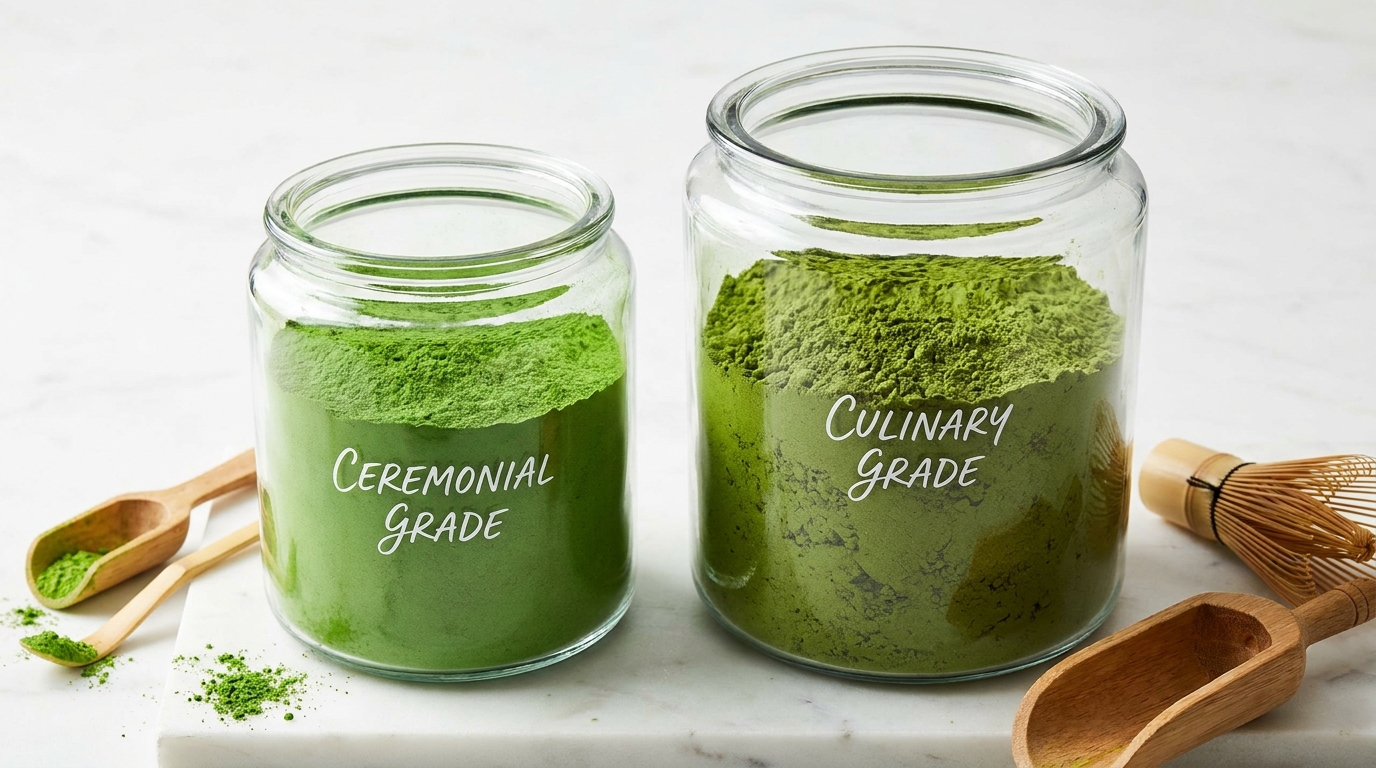
- Ceremonial Grade (First Harvest): Harvested in early spring. These leaves are the youngest and have the highest L-theanine content. The result is a vibrant green powder with a delicate, creamy umami flavor. This grade is essential for premium tea brands where the product is consumed pure.
- Premium/Latte Grade (Blend of First & Second Harvest): A versatile middle-ground. It maintains a bright color but introduces enough astringency to cut through milk and sweeteners.
- Culinary Grade (Summer/Autumn Harvest): Produced from more mature leaves. It has a bolder, more bitter profile and a slightly yellower hue. It is the industry standard for baking, confectionery, and large-scale industrial food production.
Table 1: Matcha Grade Comparison for B2B Buyers
Attribute | Ceremonial Grade | Premium/Latte Grade | Culinary Grade |
|---|---|---|---|
Harvest Season | Early Spring (1st) | Spring/Summer (1st/2nd) | Summer/Autumn |
Color | Electric, Emerald Green | Bright Green | Yellow-Green / Olive |
Flavor Profile | Creamy, Sweet, Umami | Vegetal, Balanced | Bold, Astringent, Grassy |
Amino Acid Content | Very High (L-theanine) | Moderate | Lower |
Primary Use | Pure Tea / Traditional | Lattes / Smoothies | Baking / Industrial Food |
Price Point | High ( 150/kg) | Medium ( 70/kg) | Competitive ( 35/kg) |
3. Technical Quality Indicators: Quantifying Excellence
In a B2B context, “quality” must be quantifiable. When evaluating bulk samples, professional buyers use a four-pillar framework to ensure the product meets necessary benchmarks. Sensory evaluation is a key component of this vetting process.
Professional Evaluation Metrics
- The Visual Spectrum: The color is the most immediate indicator of chlorophyll levels. High-quality matcha is shade-grown, which forces the plant to over-produce chlorophyll. A dull or brownish color suggests either poor shading, late harvest, or oxidation.
- Particle Size (Microns): Authentic matcha is ground to a particle size of 5 to 10 microns. For comparison, a human hair is about 75 microns. If the powder feels “gritty” between the fingers, it has not been ground correctly.
- The L-Theanine to Catechin Ratio: High-quality bulk suppliers should provide data on amino acid content. A high umami taste indicates high L-theanine (the “calm focus” compound), while high bitterness indicates high catechins (tannins).
- Solubility and Froth: When whisked, high-quality matcha should produce a fine, dense foam with tiny bubbles. This indicates a high concentration of saponins and proper grinding techniques.
4. Understanding the Shaded Production Process
To properly evaluate a Matcha Supplier Guide, one must understand the agricultural engineering required to produce the powder. Matcha is not just “ground green tea”; it is the result of a precise botanical intervention.
The Shading Phase (Tana)
Two to four weeks before harvest, the tea bushes are covered (traditionally with straw, now with black synthetic netting). This reduces sunlight by up to 90%, skyrocketing chlorophyll and L-theanine levels while keeping the leaves tender. This process is what differentiates what plant matcha is from compared to standard green teas.
From Aracha to Tencha
Once harvested, the leaves are steamed immediately to stop oxidation. They are then dried but—crucially—not rolled. The resulting “raw tea” (Aracha) is then refined into Tencha. This involves removing all stems (kuki) and veins (suji). What remains is the pure leaf flesh. This meticulous refinement is why high-grade matcha is so much more expensive than bulk green tea powder.
5. Organic Matcha Certification and Regulatory Compliance
For any business looking to export or sell in major retail chains (Whole Foods, Costco, etc.), compliance is non-negotiable. The “Natural” label is insufficient; you need rigorous, third-party verification.
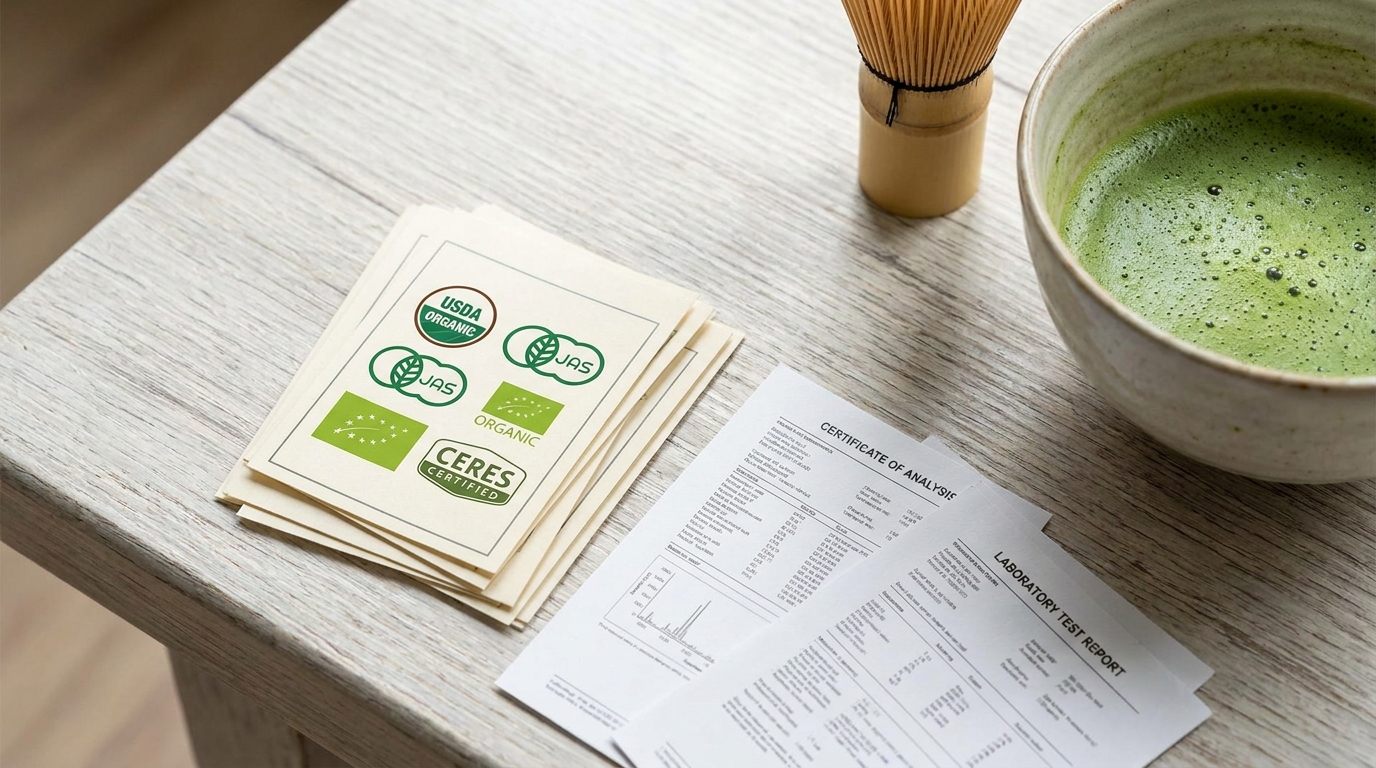
When sourcing Organic Matcha Certification, professional buyers demand the following:
- USDA Organic: Necessary for the North American market.
- EU Organic (Euro-Leaf): Required for the European Union.
- JAS (Japanese Agricultural Standard): The gold standard for Japanese production.
- HACCP/ISO 22000: Ensures food safety management systems are in place at the factory level.
Buying from a source factory with organic certificates ensures that your supply chain can withstand the scrutiny of customs and retail audits.
6. Laboratory Testing: Safety Standards for B2B Procurement
In the B2B world, safety is as important as flavor. Tea plants are bio-accumulators, meaning they can pull minerals—and toxins—from the soil. Every bulk shipment must be accompanied by a batch-specific lab report.
Table 2: Critical Laboratory Test Requirements
Test Category | Target Parameters | Significance |
|---|---|---|
Heavy Metals | Lead, Arsenic, Cadmium, Mercury | Prevents toxicity from contaminated soil. |
Pesticides | Multi-residue screening (500+ types) | Ensures compliance with “Organic” and “Zero-Residue” claims. |
Microbiological | Salmonella, E. Coli, Yeast/Mold | Ensures the product is “Ready-to-Eat” (RTE). |
Radiation | Cesium-134, Cesium-137 | Specifically for Japanese origin to ensure safety. |
Moisture Content | Below 5% | Prevents microbial growth and clumping. |
7. Private Label Matcha: Building Your Brand Infrastructure
Many businesses choose to launch their own brand rather than selling bulk powder under a supplier’s name. Private Label Matcha allows you to capture the full retail margin while leveraging the manufacturer’s scale.
A full-service partner like Riching Nutrition provides comprehensive bulk matcha wholesale and private label support . This includes:
- Custom Blending: Creating unique formulations (e.g., Matcha with Collagen, Mushroom Matcha, or Sugar-Free Latte Mixes).
- Packaging Diversity: From 30g tins for retail to 1g “on-the-go” stick packs and 1kg bags for cafes.
- OEM Branding: Utilizing high-speed automated lines to fill, seal, and label your products in a clean-room environment.
8. Logistics and Global Supply Chain Management
When buying matcha in bulk internationally, logistics is often where projects stall. A professional supplier must manage the complexity of global trade (Incoterms) and provide transparency throughout the transit.
Shipping and Lead Time Strategy
- Air Freight: Fast (5-7 days), ideal for small batches or urgent launches. High cost per kg.
- Sea Freight: Economical (30-45 days), essential for shipments over 500kg to maintain margins.
- HS Code 0902.10: Accurate classification is required to determine duties and avoid customs delays.
- Lead Times: Always account for a 2-week production window—authentic matcha is ground to order to ensure the highest possible freshness.
9. Bulk Pricing Tiers and Volume Dynamics
Bulk pricing is an exercise in volume logic. The more you buy, the lower the overhead costs (shipping, lab testing, customs clearance) are per unit.
Table 3: Bulk Pricing Tiers & MOQ Logic
Buying Level | Typical MOQ | Pricing Logic | Best For |
|---|---|---|---|
Micro-Wholesale | 10kg – 50kg | Tiered Retail | Small Cafes / Boutique Tea Shops |
Professional Bulk | 100kg – 500kg | Direct Factory Price | Regional Brands / Multi-unit Cafes |
Industrial Scale | 1,000kg+ | Contract Pricing | Global Beverage Brands / Supplements |
Private Label | 500+ Units | Unit Price + Tooling | Amazon FBA / Retail Product Launches |
10. Preservation Science: Storing Bulk Matcha for Longevity
Matcha is a “living” product. It is highly sensitive to light, heat, and oxygen. In a warehouse or kitchen environment, improper storage can turn a premium ceremonial matcha into a bitter, brown powder in weeks.
The “Four Enemies” of Matcha
- Oxygen: Causes oxidation, turning the green chlorophyll into brown pheophytin.
- Light: UV rays degrade the color and flavor rapidly.
- Heat: Accelerates the loss of nutrients and aroma.
- Moisture: Can lead to clumping, loss of fine texture, and eventually mold.
Business Recommendation: Bulk matcha should always be shipped in nitrogen-flushed, aluminum-polymer bags. Once it arrives, store it in a cool, dark place (ideally refrigerated at 5°C). For industrial use, only open what you can use in a single production shift.
11. Vetting Suppliers: The Professional Audit Checklist
Before signing a long-term supply contract, you must conduct thorough due diligence. A Matcha Supplier Guide isn’t just about the product; it’s about the partnership.
- Sample Consistency: Do the 5kg test batch and the 500kg bulk order match? Professional suppliers use “standardized blending” to ensure the flavor profile remains identical across harvests.
- Facility Certifications: Does the factory hold BRC, SQF, or ISO certifications? This proves they follow international food safety standards.
- Transparency: Will they show you the tea gardens? A direct manufacturer should be able to provide photos, GPS locations, or virtual tours.
- Responsiveness: A supplier who takes days to answer an email will likely be a bottleneck during a logistics crisis.
- Financial Stability: Ensure the supplier has the capacity to scale. A “broker” might disappear; a factory with 4,000,000 ㎡ of tea farms is built for the long term.
12. Future Trends in the Global Bulk Matcha Market
The matcha industry is evolving. We are seeing a move away from simple “powder in a bag” toward functional, value-added products. Innovations like cold-water soluble matcha and organic jasmine-infused matcha are opening new doors for ready-to-drink (RTD) beverage manufacturers.
Furthermore, the rise of the “sober-curious” movement has skyrocketed demand for matcha as a sophisticated alcohol alternative. For bulk buyers, staying ahead of these trends means working with a supplier that invests in R&D and understands the shifting landscape of consumer wellness.
Frequently Asked Questions
Original FAQs
- How long does bulk matcha last? Unopened, nitrogen-flushed bulk matcha has a shelf life of 24 months. Once opened, it should be used within 2-3 months.
- What is the difference between culinary and ceremonial matcha? Ceremonial is for drinking pure (sweet, vibrant green); culinary is for baking/lattes (bold, slightly bitter).
- Is Chinese matcha as good as Japanese matcha? High-altitude organic farms in China now produce grades that rival Japanese quality at a more competitive price point.
- What is the minimum order quantity (MOQ)? MOQs typically start at 10kg for wholesale and 500 units for private label.
NEW Professional FAQs
- Can you provide custom particle sizes for pharmaceutical use? Yes. We can adjust milling speed and duration to reach specific micron levels (e.g., 5-8 microns) for tablet compression or encapsulation.
- Is your matcha tested for radiation? Absolutely. Every batch comes with a radiation-free certificate covering Cesium and Iodine isotopes, regardless of origin.
- Do you offer “Stick Pack” packaging for RTD brands? Yes, we offer 1g to 5g stick packs with custom printing, which are ideal for the “on-the-go” supplement market.
- How do you ensure color consistency throughout the year? We utilize a standardized blending process where tencha from different harvests is masterfully mixed to maintain a specific color and flavor profile for a brand.
- Can I request a factory audit? Yes. We welcome third-party audits (like Sedex or brand-specific audits) to ensure our facility meets your internal ethical and safety standards.
“In the world of bulk commodities, price is a moment, but quality is a reputation. Choose the latter to ensure the former takes care of itself.”
For a consultation on your bulk matcha needs or to request a sample of our certified organic grades, visit Riching Matcha or explore our wholesale solutions .