
Before committing capital to a private label matcha venture, B2B buyers must understand the structural differences of the market, identify their target customer segments, and confirm crucial operational parameters.
1. What is Private Label Matcha?
Private label matcha is the business model where a specialized manufacturer produces, mills, blends, and packages high-grade green tea powder under your brand’s name, logo, and design specifications. Unlike wholesale purchasing of bulk raw material, private label programs provide retail-ready or service-ready finished goods, shifting the burden of manufacturing compliance, laboratory analysis, high-speed packing, and quality control onto a certified primary processor.
2. Which Businesses are Best Suited for Private Label Matcha?
- Café Chains and Beverage Brands: Desiring custom-formulated matcha powders (such as sweetened latte mixes or single-serve packets) to ensure drink consistency across multi-unit retail locations.
- Importers and Food Service Distributors: Seeking to supply hospitality clients, bakeries, and regional coffee networks with proprietary, consistent ingredient solutions.
- Retail Supermarkets and E-commerce Brand Owners: Focused on building brand equity, capitalizing on high-margin natural wellness trends, and maintaining pricing control over direct-to-consumer (DTC) channels.
- Nutraceutical and Functional Food Manufacturers: Developing proprietary powders, health blends, or capsule formulations requiring specific active compound markers (e.g., specific L-theanine or polyphenol concentrations).
3. What are the Typical Steps From Sample Evaluation to Formal Launch?
The critical path of private label execution follows a highly structured milestone timeline designed to eliminate formulation risks, customs delays, and quality degradation:
Market Positioning → Matcha Selection → Supplier Verification → Sampling → Packaging → Production → Import → Marketing → Scaling
4. What Information Must a B2B Purchaser Confirm Before Contacting a Supplier?
An experienced procurement officer must never contact a primary processor without having established the following data points:
- Target Retail Unit Price and Cost of Goods Sold (COGS) Limits: Essential to determine whether to source premium Japanese tea or cost-effective raw ingredients.
- Required Regulatory Certifications: Verify if the target market mandates JAS, USDA Organic, EU Organic, Kosher, Halal, or specific GFSI-level factory certifications.
- Expected Annual Purchase Volume and Initial MOQ Capabilities: Ensuring the business aligns with the factory’s industrial packing run minimums.
- Packaging Specifications: Confirming if the product will be packed in 30g tins, 100g bags, 1kg bulk bags, or 1g to 3g single-serve stick packs.
1: Understanding Private Label, White Label, and OEM Matcha
Definitions and Core Distinctions
In B2B sourcing, terms like private label, white label, and OEM (Original Equipment Manufacturer) are frequently used interchangeably, yet they represent distinctly different operational workflows, capital expenditure requirements, and custom-formulation boundaries.
- White Label: The manufacturer produces a generic, off-the-shelf product (such as standard culinary grade matcha in a plain black aluminum tin) and applies a simple adhesive label with your brand assets. This is the fastest route to market with low capital requirements, but offers zero differentiation from competitors.
- Private Label: The brand owner works with the supplier to select a specific, customized raw material grade, customizes the packaging from the ground up (such as custom-printed film rolls or direct-printed tins), and registers a unique SKU. This builds authentic brand equity and secures market positioning.
- OEM / ODM (Original Design Manufacturer): Represents a highly complex, collaborative manufacturing partnership. This level involves custom blending (e.g., adding adaptogens like Lion’s Mane mushroom or functional ingredients like marine collagen to a specific grade of matcha) or engineering proprietary processing steps, such as instant-dissolve cold-brew matcha.
To explore customized manufacturing partnerships, brands utilize Private Label Matcha OEM/ODM Services to design bespoke formulations matching specific market preferences.
Comparative Industry Analysis
The table below highlights the operational trade-offs across these three sourcing models:
Operational Variable | White Label Matcha | Private Label Matcha | OEM / ODM Custom Matcha Blends |
|---|---|---|---|
Typical Minimum Order Quantity (MOQ) | Very Low (100 – 500 units) | Medium (1,000 – 5,000 units) | High (5,000 – 10,000+ units) |
Formulation Customization | None (Generic supplier stock grades) | Selectable (Choice of raw grades or standard blends) | Deep (Custom functional additives, flavors, sweeteners) |
Packaging Level | Adhesive sticker applied to stock tins/pouches | Fully custom-printed bags, tins, box cartons | Bespoke outer boxes, custom stick sizes, unique tins |
R&D Lead Time | 1 – 2 Weeks | 4 – 8 Weeks | 12 – 24 Weeks |
Typical Gross Margin Potential | 40% – 50% | 60% – 75% | 70% – 85%+ |
Regulatory Burden | Minimal (Supplier’s certifications apply) | Medium (Labels must comply with local FDA/EFSA rules) | High (Bespoke nutritional testing, novel food compliance) |
2: The Strategic B2B Business Case for Private Label Matcha
Market Dynamics and Margin Profiles
The global matcha market has transitioned from a niche, ceremonial-use green tea into a dominant ingredient category spanning the beverage, bakery, confectionery, cosmetics, and nutraceutical industries. Unlike loose-leaf green teas, which suffer from fluctuating steep times and complex consumer preparation, matcha is an instantized, whole-leaf functional powder that dissolves completely in liquids, making it perfect for modern food-service applications.
From a margin perspective, matcha remains one of the most profitable SKU profiles in the natural products sector. Standard culinary-grade matcha purchased in bulk at competitive commercial rates can be packaged and positioned at retail with a markup ranging from 300% to 800%. By moving from a third-party brand distributor model to a direct private-label model, a business can capture the intermediary margin, shifting COGS downwards while driving brand equity upwards.
Segment-Specific Advantages
Different business models capture diverse strategic benefits through a private label program:
B2B Business Segment | Primary Operational Pain Point Solved | Strategic Private Label Advantage |
|---|---|---|
Importers & Large Wholesalers | High price sensitivity on unbranded bulk commodities. | Transition from raw-material broker to proprietary brand owner; locked-in customer loyalty. |
Regional Distributors | Price wars with competing distributors carrying identical brands. | Exclusive territorial rights over a proprietary brand; shielded from direct price matching. |
Multi-Unit Café Chains | Inconsistent drink quality and taste profiles across store locations. | Pre-sweetened, highly soluble portion-controlled packs ensuring identical flavor nationwide. |
Grocery Supermarkets | Low profit margins on highly visible multinational tea brands. | “Control Brand” positioning, providing high-quality matcha at an attractive price point with 50%+ gross margins. |
3: Botanical Foundations: Tea Cultivars and Agricultural Metrics
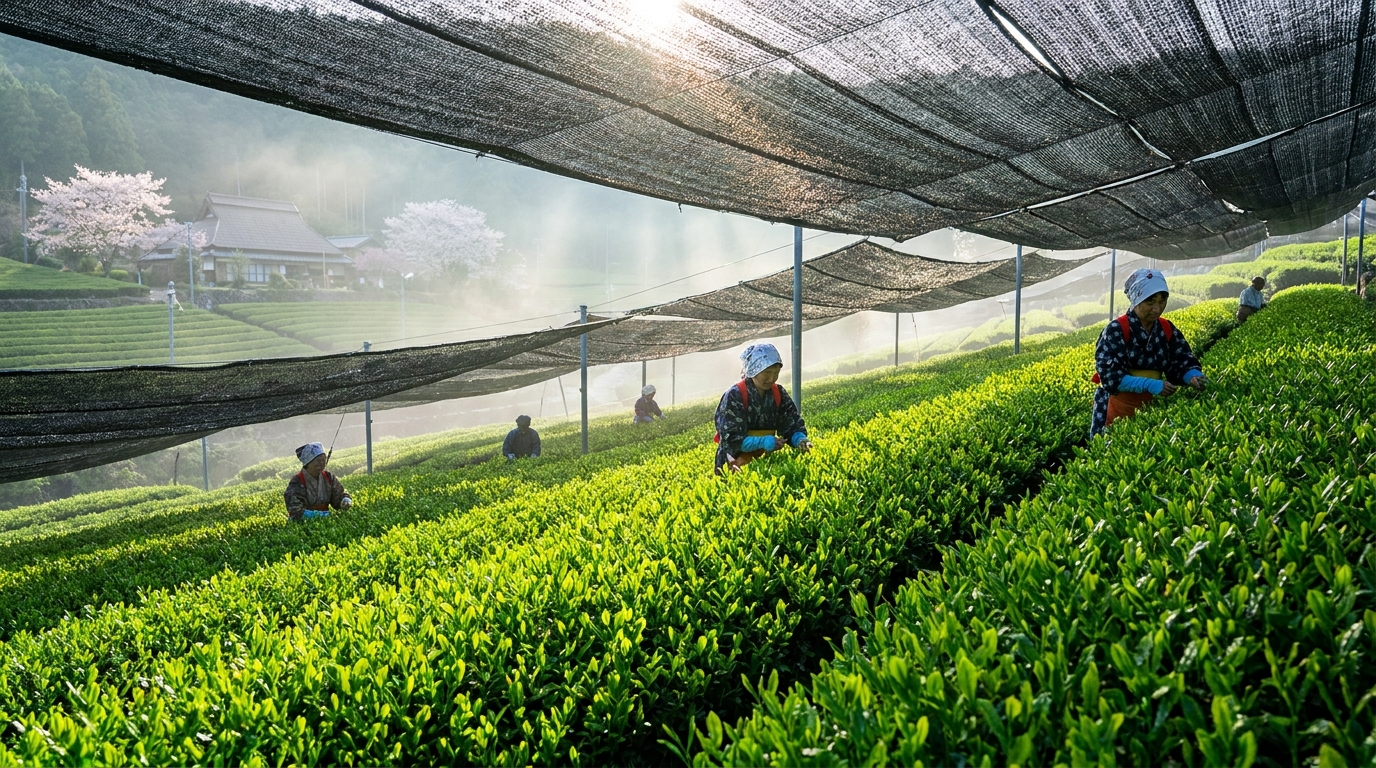
An expert B2B buyer must evaluate matcha from an agronomic and biochemical perspective. True matcha is milled exclusively from Tencha (shade-grown Camellia sinensis leaves that are dried, de-veined, and de-stemmed). Understanding the cultivar and the growing process is critical for quality control.
Dominant Cultivars
Just as wine is defined by grape varietals, matcha’s organoleptic properties are determined by tea plant cultivars:
- Yabukita: The backbone of the Japanese green tea industry, accounting for approximately 70% of total cultivation. It is highly resilient, frost-hardy, and provides a classic, astringent green tea flavor with a balanced, slightly bitter finish. It is primarily used in premium culinary and standard beverage-grade matcha.
- Okumidori: A late-budding cultivar that avoids late spring frosts. It produces an exceptionally round, smooth, deep-green liquor with low bitterness. It is highly sought-after for high-tier café and Ceremonial Matcha Powder profiles.
- Saemidori: An early-budding, high-quality cultivar known for its bright, vivid neon-green color and exceptional umami sweetness. It possesses low astringency and high chlorophyll content, making it the gold standard for luxury ceremonial products.
Shading Science and Amino Acid Biosynthesis
The defining agricultural step of authentic matcha is shading (Tana process). Approximately 20 to 30 days before the spring harvest, the tea fields are covered with black netting (shading structures), blocking 90% to 98% of direct sunlight.
This light deprivation alters the plant’s biological processes:
- L-Theanine Preservation: In unshaded tea plants, sunlight converts L-theanine (the amino acid responsible for sweet, savory umami flavor and cognitive calm) into polyphenols and catechins (which contribute astringency and bitterness). Shading halts this conversion, preserving high concentrations of L-theanine in the leaves.
- Chlorophyll Hyper-Production: Denied sunlight, the plant overproduces chlorophyll to maximize energy absorption. This elevates the raw leaves’ pigment to a deep emerald green, giving true ceremonial matcha its vibrant color.
Harvest Timing
The crop harvest calendar dictates the final grading, cost, and usage parameters of the finished powder:
- First Flush (Spring Harvest – April to May): These young, tender, hand-picked or gently machine-harvested leaves contain the highest density of L-theanine, amino acids, and chlorophyll. First-flush leaves are processed exclusively into elite ceremonial-grade matcha.
- Second Flush (Summer Harvest – June to July): These leaves develop faster under higher temperatures, leading to a drop in amino acids and an increase in catechins. This crop yields a bolder flavor with noticeable astringency—ideal for dairy or plant-milk lattes.
- Third Flush / Autumn Harvest (August to September): Composed of mature, tough leaves with lower nutrient density. This harvest is processed into standard culinary grades for baking, industrial food formulation, and extraction.
4: Manufacturing and Processing: Tencha to Matcha Powder
Sourcing premium matcha requires understanding the manufacturing steps that transform fresh green tea leaves into ultra-fine powder.
Fresh Leaf Harvesting → High-Pressure Steaming (Aracha) → Blast Cooling → Drying (Tencha-Ro) → Sorting, De-veining & De-stemming (Tencha) → Fine Milling (Finished Matcha)
From Fresh Leaf to Tencha: Steaming, Drying, and De-veining
Within hours of harvest, the fresh leaves undergo processing at primary factory stations:
- High-Pressure Steaming: Leaves are subjected to brief, intensive steaming (30 to 40 seconds) to deactivate the polyphenol oxidase enzymes. This preserves the bright green color and halts oxidation, preventing the leaves from turning brown.
- Blast Cooling: The steamed leaves are propelled upward through vertical wind columns to rapidly cool them and disperse surface moisture.
- Drying (Tencha-Ro): The leaves are slowly dried in multi-stage conveyor ovens (Tencha-Ro) without being rolled (unlike Sencha processing). Rolling breaks leaf cells and releases juices; avoiding this keeps the structural integrity of the leaf intact. This unrolled, dried leaf material is known as Aracha.
- Sorting, De-veining, and De-stemming: The Aracha is passed through specialized air-cyclone classifiers, electrostatic sorters, and cutting machinery to remove the stems and veins (Suka). What remains are pure, clean, uniform leaf flakes known as Tencha.
Fine Milling Technologies: Stone Mill vs. Jet Mill vs. Ball Mill
The milling technology utilized directly impacts particle size, heat-induced oxidation, and the sensory profile of the finished powder:
- Traditional Granite Stone Milling:
- Mechanism: Tencha is fed through slow-rotating granite stone wheels.
- Throughput: Extremely slow, typically producing only 30g to 40g of powder per hour per stone.
- Particle Morphology: Round-edged particles ranging from 5 to 10 microns.
- Quality: Stone milling produces no friction heat, preserving volatile flavor compounds, chlorophyll, and L-theanine. This is the exclusive milling method for ultra-premium ceremonial matcha.
- Industrial Jet Milling (Air Jet Grinding):
- Mechanism: High-pressure, chilled compressed air forces Tencha particles to collide with one another at supersonic speeds, fracturing them into an ultra-fine powder.
- Throughput: High-speed industrial scale, producing 50kg to 200kg+ per hour.
- Particle Morphology: Slightly angular particles, averaging 10 to 15 microns.
- Quality: Exceptional uniformity, rapid dissolution, and cold-temperature control systems prevent leaf burning. This is the optimal mill format for high-speed private label packaging of café and premium retail grades.
- Industrial Ball Milling:
- Mechanism: Tencha is placed in rotating drums containing ceramic or stainless-steel grinding balls.
- Throughput: High volume, very low cost.
- Particle Morphology: Highly variable, often exceeding 20 microns.
- Quality: High friction heat can lead to a dull yellow-green color and a scorched, burnt aroma. This is primarily used for industrial baking and culinary grades.
Heat Sensitivity and Granulometry Control
Matcha is highly sensitive to heat. During milling, temperatures above 45°C degrade chlorophyll (turning the powder brown) and volatilize delicate sweet aroma compounds. Advanced manufacturing facilities utilize liquid nitrogen or chilled water-jacketed air systems to keep processing chambers below 35°C, ensuring the powder retains its bright color and sensory qualities.
5: Deciphering Matcha Grades and Classifications
For a purchasing director, choosing the right grade is a balance of sensory quality, cost, and intended application.
Sensory Differentiation: Color, Aroma, and Flavor Profiles
An experienced taster evaluates matcha across four distinct sensory dimensions:
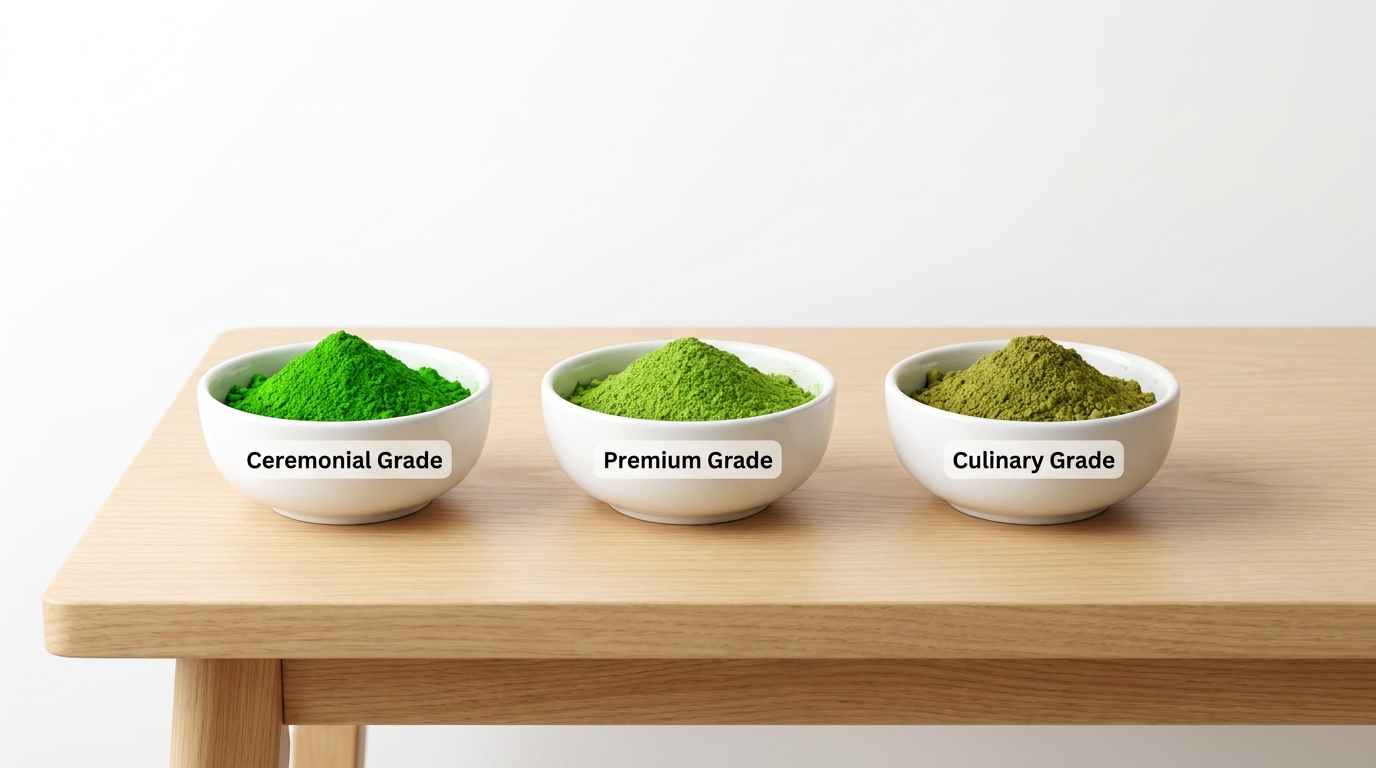
- Color: Premium grades display a vivid, luminous emerald green. Middle grades range from a rich grass green to jade green. Lower culinary grades trend toward army green, khaki, or dull olive yellow due to high sun exposure and late harvesting.
- Aroma: Ceremonial grades offer aromas of fresh grass, toasted nuts, sweet cream, and deep marine umami. Culinary grades lean toward heavier, toasted, hay-like, or distinctly astringent notes.
- Texture & Solubility: High-grade matcha feels like silk or talcum powder between the fingers (5 to 10 microns). Lower grades feel slightly gritty (20+ microns) and precipitate rapidly out of suspension when mixed with water.
- Taste: Premium ceremonial matcha presents deep umami, a thick mouthfeel, and zero bitterness. High-to-mid beverage grades offer a crisp green flavor with mild astringency that pairs well with milk. Culinary grades have a distinct bitterness and astringency that cuts through heavy fats and sugars in baked goods.
Chemical Profiles: Amino Acids, L-Theanine, Catechins, and Caffeine
The internal biochemistry of the leaf varies by grade:
- L-Theanine: Ranges from 20mg to 40mg per gram in top-tier spring harvest tea, dropping below 5mg per gram in late autumn culinary crops.
- Catechins (Epigallocatechin Gallate – EGCG): Lower in shaded spring leaves, but higher in unshaded summer/autumn harvests. EGCG provides antioxidant benefits and contributes a bitter, astringent taste profile.
- Chlorophyll: Highest in shaded spring crops, providing the bright green color.
- Caffeine: Shaded leaves yield higher caffeine levels (up to 3.5% dry weight) than unshaded leaves, acting as a natural defense mechanism for the plant.
Grading Matrices
The table below maps specific matcha grades to their optimal industrial applications and pricing levels:
Matcha Grade Name | Primary Cultivars & Harvest | Key Organoleptic Profile | Recommended B2B Use Case | Relative Cost Level |
|---|---|---|---|---|
Bespoke Ceremonial (Competition Grade) | Saemidori / Okumidori; First Flush, hand-picked. | Luminous neon-green; zero bitterness, intense creamy sweet umami. | Elite luxury gifting, traditional tea drinking. | $$$$$ (Super Premium) |
Traditional Ceremonial | Okumidori / Yabukita; First Flush, machine-harvested. | Deep jade green; toasted nutty aroma, delicate mild sweet cream finish. | Premium retail brands, high-end organic lines. | $$$$ (Premium) |
Premium Café Grade | Yabukita blend; Late First Flush / Early Second Flush. | Bright spring green; balanced brisk tea flavor, light sweet finish. | Specialty café latte powders, functional wellness mixes. | $$$ (Medium-High) |
Culinary Grade A (Beverage-Grade) | Yabukita / Summer Harvest blend. | Herbaceous light green; medium astringency, bold tea flavor. | Standard food-service lattes, bottled RTD beverages, ice cream. | $$ (Medium-Low) |
Culinary Grade B (Baking / Industrial) | Autumn Harvest mature leaves. | Dull olive green; high bitterness, heavy toasted grass aroma. | Large-scale baking, chocolate, protein powders, pet supplements. | $ (Economy) |
For luxury retail brands, sourcing authentic Ceremonial Matcha Powder ensures the vibrant color and smooth umami profile demanded by premium tea consumers.
6: Sourcing Strategy: Origin and Terroir Considerations
Terroir (soil chemistry, elevation, humidity, and microclimate) plays a critical role in the final flavor profile and safety metrics of the tea leaves.
Geographical Terroirs of Japan
- Uji (Kyoto Prefecture): The historical cradle of Japanese green tea. Uji’s misty river valleys, mineral-rich soils, and steep temperature fluctuations between day and night produce elegant, highly complex ceremonial matcha with a distinct umami sweetness. It remains the most globally recognized origin, commanding a premium price.
- Kagoshima (Kyushu Island): Japan’s volcanic powerhouse. Known for its wide, flat plains and highly mechanized, volcanic-ash-enriched organic farming operations. Kagoshima excels at producing USDA and EU organic certified matcha with a clean, vibrant taste profile. It is the leading source for competitive, large-scale organic private-label programs.
- Shizuoka: Situated near Mount Fuji, this region produces robust, bold, and mineral-dense teas. While traditionally famous for Sencha, Shizuoka has expanded its matcha processing facilities, offering reliable culinary and beverage grades.
Sourcing from Global Tea Farms
To meet rising global demand and support cost-conscious projects, modern tea producers have established massive shade-grown tea farms globally. Emerging tea fields in regions with favorable microclimates supply large-scale food service distributors, cosmetics companies, and functional food manufacturers. This global cultivation offers a reliable, scalable supply chain with consistent pricing, insulating buyers from the higher costs associated with premium domestic Japanese origins.
Supply Chain Risks, Seasonality, and Climate Impact
B2B buyers must anticipate seasonal supply disruptions:
- The Spring Bottleneck: Since the highest-quality ceremonial grades are harvested only once a year in spring, buyers must secure their annual allocations by May/June to avoid winter shortages.
- Macro-Climate Fluctuations: Late spring frosts can destroy young tea buds, while intense typhoons can damage shade netting, leading to localized grade shortages and pricing volatility.
- Ocean Freight and Customs Delays: Given that marine transit from origin ports to Western destination ports typically spans 35 to 60 days, global brands must maintain a 3-month safety stock.
7: Supplier Vetting, Auditing, and Verification
Selecting a private-label manufacturer is one of the most critical decisions in your product development cycle. A thorough supplier vetting process helps prevent quality variations, regulatory compliance issues, and sudden supply chain disruptions.
Assessing Supplier Infrastructure and Financial Stability
Before evaluating samples, buyers must confirm that a prospective supplier possesses the industrial capacity to scale with their brand. Key infrastructure indicators include:
- Direct Sourcing Capabilities: Does the supplier own tea farms or maintain exclusive long-term contracts with regional farming cooperatives? Avoid middlemen brokers who cannot guarantee raw material traceability.
- Processing Capacity: Does the facility have modern stone-grinding or jet-milling equipment on-site, or do they outsource milling to third parties?
- Supply Chain Transparency: Can the factory trace a finished batch of matcha back to the specific field, harvest date, and batch processing log?
Factory Auditing and Verification Protocols
When evaluating potential partners, use this detailed Matcha Supplier Evaluation Checklist to verify the factory’s operational standards:
Evaluation Criteria | Verification Standard & Requirement | Audit Score (1-5) | Verification Method |
|---|---|---|---|
Traceability Protocols | Fully documented chain of custody from farm coordinates to shipped carton. | Review batch records and farm map coordinates. | |
Mill Temperature Controls | Continuous electronic temperature logging; mill chamber kept under 35°C. | On-site physical inspection of milling lines. | |
Heavy Metal Sorter Systems | Automated high-resolution magnetic and electrostatic sorters. | Inspect processing flowcharts and raw material intake stations. | |
Contamination Controls | Positive air pressure cleanrooms, strict HEPA filtration, and clean-in-place (CIP) protocols. | Verify air-handling layouts and daily cleaning logs. | |
Foreign Matter Detection | X-ray inspect machines and high-frequency magnets installed prior to packaging. | Request calibration logs and watch real-time product screening. | |
In-House Testing Labs | On-site analytical laboratory equipped with HPLC and moisture balance analyzers. | Confirm presence of certified lab technicians and testing equipment. |
8: Compliance and Documentation: The B2B Paperwork Trail
Importing agricultural powders into highly regulated markets (such as the US, EU, Canada, and Australia) requires comprehensive, scientifically verified documentation.
Mandatory Global Food Safety Standards
The manufacturing facility must hold GFSI (Global Food Safety Initiative) recognized food safety certifications, such as FSSC 22000, SQF (Level 2 or 3), or BRCGS. These certifications verify that the factory operates under strict HACCP (Hazard Analysis Critical Control Point) plans, managing critical hazards such as metal contamination, allergen cross-contact, and microbial development.
Technical Data Sheets and Certifications
When importing matcha, every shipment must be accompanied by the documents listed in the Private Label Matcha Supplier Document Checklist:
Document Name | Technical Purpose | Critical B2B Sourcing Parameters to Verify |
|---|---|---|
Certificate of Analysis (COA) | Batch-specific scientific testing results. | Verify that the specific batch matches contract specifications for moisture, ash, and lead levels. |
Heavy Metal Lab Report | ICP-MS testing verifying compliance with international heavy metal standards. | Ensure Lead (Pb) is < 1.0 ppm, Arsenic (As) is < 1.0 ppm, and Cadmium (Cd) is < 0.1 ppm. |
Multi-Pesticide Residue Screen | Gas Chromatography-Mass Spectrometry (GC-MS) screen for over 400 agrochemical compounds. | Confirm that pesticide residues are either non-detectable or fall below the importing country’s MRLs. |
Microbiological Analysis | Plating testing confirming lack of harmful pathogens. | Ensure Total Plate Count (TPC) is < 10,000 CFU/g, Yeast & Mold is < 100 CFU/g, and E. coli/Salmonella are Negative. |
Technical Data Sheet (TDS) | Document detailing the physical and chemical properties of the product. | Check particle size parameters (e.g., D50D_{50} < 12 microns) and confirm the raw botanical name is 100% Camellia sinensis. |
Material Safety Data Sheet (MSDS) | Safety guidelines for shipping and industrial handling. | Confirm that the product is classified as non-hazardous, non-combustible, and safe for transport. |
Phytosanitary Certificate | Certificate issued by the exporting country’s agricultural department. | Confirm that the tea is free from pests, diseases, and restricted biosecurity contaminants. |
9: The Science of Organic Matcha Certification
“Organic” is more than a marketing term; it is a highly regulated legal classification. For brands targeting natural foods supermarkets, organic certification is a key requirement for market entry.
To capture this growing market, brands leverage certified Organic Matcha Powder to meet global compliance standards.
Understanding JAS, USDA Organic, and EU Organic Systems
The three major organic regulatory bodies have established equivalence agreements, yet key operational differences remain:
- JAS (Japanese Agricultural Standard): Managed by Japan’s Ministry of Agriculture, Forestry and Fisheries (MAFF). It is the base organic certification for Japanese matcha. Under equivalence agreements, JAS-certified matcha can be imported directly into the US and EU as organic, provided specific chain-of-custody documentation is maintained.
- USDA National Organic Program (NOP): Mandates that no synthetic fertilizers, herbicides, or pesticides are used. Organic tea gardens rely on natural fertilizers, such as composted fish meal, rapeseed meal, and organic matter.
- EU Organic (EC 834/2007): Possesses some of the strictest pesticide residue limits in the world. Organic farms exporting to the EU must maintain a significant physical buffer zone from conventional tea farms to prevent wind-borne pesticide drift.
Regulatory Testing for Pesticide Residues and Heavy Metals
Because green tea leaves are dried and milled in their entirety, any contaminants on the leaf surface are concentrated in the final powder. Standard import screening includes:
- Lead Contamination: Tea plants are natural accumulators of lead from the soil. Clean farms located away from industrial centers and major highways consistently produce matcha with lead levels well below 1.0 ppm.
- Pesticide Drift: Even if a farm is certified organic, adjacent conventional farms can cause cross-contamination. Sourcing from large, consolidated organic tea farms minimizes the risk of accidental drift.
Organic Co-packing and Traceability Auditing
To maintain an organic claim on retail packaging, both the milling factory and the final packaging facility must hold active organic certifications. If a non-certified co-packer handles organic matcha powder and places it into tins, the organic status is legally voided. The entire supply chain must maintain an unbroken chain of custody, supported by organic Transaction Certificates (TCs) for every transaction.
10: Step-by-Step Sample Evaluation and Quality Assurance
Before signing a supply contract, procurement teams must perform a structured sensory and laboratory evaluation of potential samples.
Establishing the Sensory Panel
Conduct all sensory tests under neutral, color-corrected lighting (D65 daylight standard) using identical equipment:
- Visual Evaluation of Dry Powder: Spoon 5g of matcha onto clean white paper. Observe the color under natural light. Drag a flat card across the powder to check for clumping and graininess.
- Aroma Evaluation: Place 2g of matcha into a ceramic bowl (Chawan). Pour in 70ml of hot water (80°C). Whisk gently and evaluate the initial aroma.
- Taste and Mouthfeel (Umami vs. Astringency): Take a small sip of the whisked matcha, aerate it across your palate, and evaluate the balance of umami, sweetness, bitterness, and astringency. Note the clean-drinking finish or any lingering bitterness.
Analytical Testing: Particle Size, Moisture Content, and Microbiology
To complement your sensory evaluation, submit samples to an independent ISO-certified third-party laboratory to verify the following parameters:
- Laser Diffraction Particle Size Analysis: High-quality matcha should show a narrow particle size distribution, with a D50D_{50}
between 5 and 12 microns. A high proportion of particles over 25 microns indicates poor milling, which can cause a gritty mouthfeel and rapid settling in beverages.
- Loss on Drying (Moisture Content): The moisture level must be under 5.0% (ideally between 3.0% and 4.5%). Moisture levels above 5.5% accelerate oxidation, turning the green powder brown and giving it a stale, seaweed-like aroma.
Scoring and Decision-Making
Use this structured Sample Evaluation Scorecard to compare samples from different suppliers:
Quality Parameter | Evaluation Target & Standard | Weight | Supplier A Score (1-10) | Supplier B Score (1-10) |
|---|---|---|---|---|
Color (Dry) | Luminous, bright emerald green. | 25% | ||
Color (Wet) | Deep jade green; dense, uniform emerald foam. | 15% | ||
Aroma | Sweet grass, fresh cream, rich umami; no stale or burnt smell. | 20% | ||
Taste Profile | Balanced umami and sweetness; minimal bitterness or astringency. | 20% | ||
Solubility & Texture | Silky texture; easily suspended in water with no bottom settling. | 10% | ||
Moisture Level | Lab-verified moisture content between 3.0% and 4.5%. | 10% | ||
Total Score | Weighted Average (100% Max) | 100% |
11: Packaging Customization: Retail Formats and MOQ Realities
The shelf life and color stability of matcha depend heavily on the quality of its packaging. Sourcing decisions must balance visual appeal with high-barrier protection.
Low-MOQ Packaging vs. Fully Customized Packaging
Starting brands often face a trade-off between keeping initial order volumes low and achieving a fully customized retail look. The table below outlines the key differences between these two approaches:
Packaging Variable | Low-MOQ Stock Packaging | Fully Customized Brand Packaging |
|---|---|---|
Typical Minimum Order Quantity (MOQ) | 1,000 – 2,000 Units | 10,000 – 20,000+ Units |
Manufacturing Method | Off-the-shelf blank tins/bags; custom paper labels applied by hand or machine. | Direct-to-tin lithographic printing or custom rotogravure/digital bag printing. |
Unit Packaging Cost | Higher ( 1.50–1.50 – 3.00+ per unit due to manual labeling and short runs) | Lower ( 0.50–0.50 – 1.20 per unit at high volumes) |
Oxygen Barrier Protection | Medium (Depends on the barrier quality of the stock bag or tin used) | Maximum (Engineered multi-layer films with integrated aluminum barriers) |
Visual Appeal | Clean and professional, but limited by label edges and stock sizes. | Premium, seamless retail presentation with custom finishes and spot UV. |
Inner Barrier Technology: Aluminum Foil, Metalized PET, and Tinplate
Matcha is highly sensitive to oxygen, light, heat, and moisture. Exposure to these elements degrades chlorophyll (turning the powder brown) and oxidizes L-theanine (resulting in a bitter taste).
To prevent this, high-quality packaging must use advanced barrier materials:
- Aluminum Foil (AL): The gold standard for barrier packaging, offering an absolute barrier to light, oxygen, and moisture.
- Metalized PET (VMPET): A cost-effective alternative to aluminum foil that offers excellent oxygen and moisture barrier properties, suitable for mid-tier retail bags.
- Tinplate (Tin Cans): Standard tins must include an inner heat-sealed food-grade aluminum pouch or a pull-ring aluminum lid to prevent oxygen exposure during storage and transport.
Professional Visual Appeal
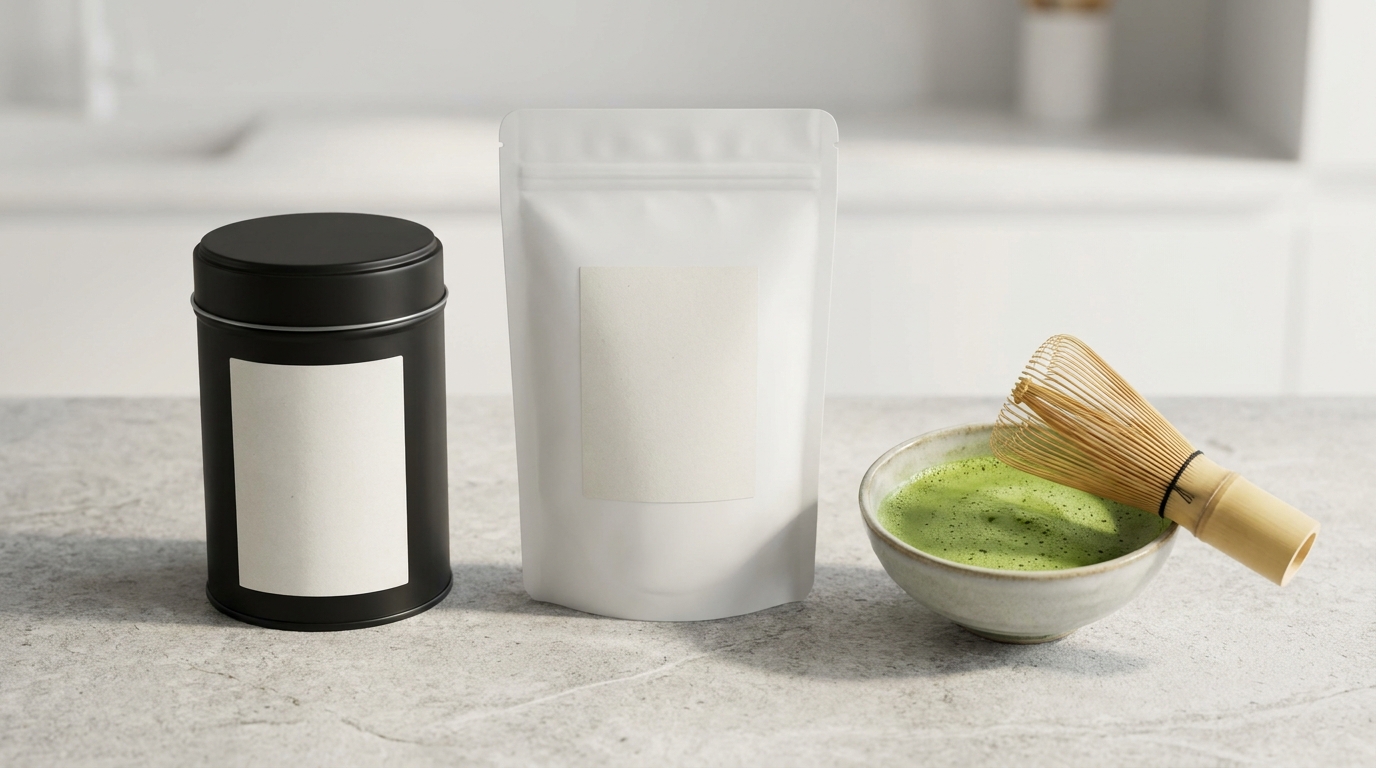
Investing in high-quality packaging design is essential for positioning your brand in the competitive retail market. A clean, premium presentation helps communicate your product’s quality and justifies a higher retail price.
12: Detailed Packaging Formats: Tins, Pouches, and Stick Packs
Choosing the right packaging format depends on your target customer, distribution channel, and product positioning.
Stand-Up Pouches vs. Metal Tins vs. Bulk Packaging
- Stand-Up Pouches (Resealable Zipper Pouches): Highly popular for retail weights from 50g to 250g. Excellent for culinary and café-grade products. Ensure the design features a matte finish and a high-barrier resealable zipper to keep the powder fresh after opening.
- Metal Tins (30g – 80g): The classic, premium format for high-end ceremonial matcha. Tins protect the delicate powder from physical crushing and light damage. They are typically sealed with an inner foil membrane or a pull-top ring lid.
- Bulk Foil Bags (1kg – 25kg): Used primarily for food service, bakeries, café chains, and industrial food processing. The powder is vacuum-packed in thick, heavy-duty double-layered aluminum foil bags, which are then packed into sturdy corrugated export master cartons.
The Mechanics of Single-Serve Stick Packs
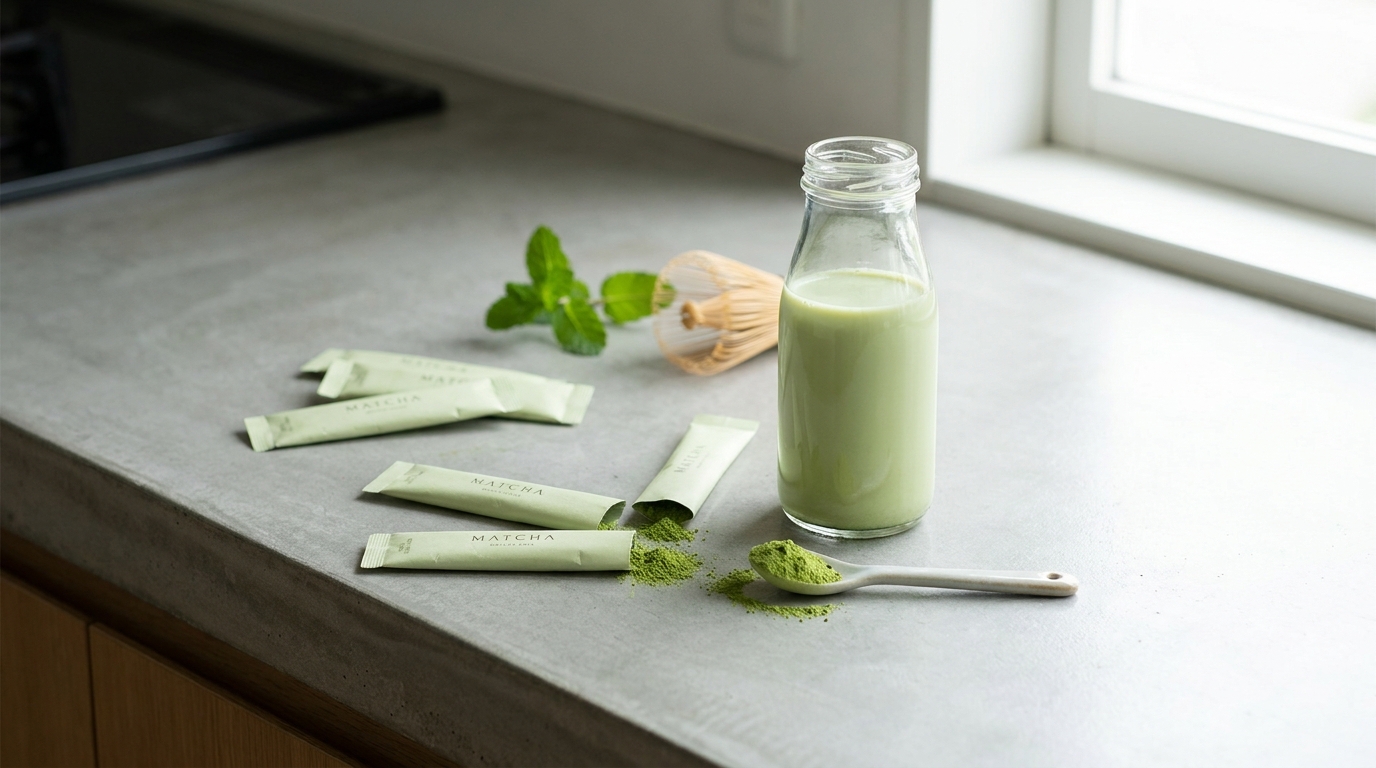
For busy consumers and on-the-go professionals, single-serve stick packs (typically 1g to 3g) offer a highly convenient option. Stick packing requires specialized, high-speed vertical form-fill-seal (VFFS) machinery equipped with powder-dosing systems.
The table below compares the technical specifications and use cases of the main packaging formats:
Packaging Format | Common Target Weights | Technical Material Structure | Oxygen Barrier Rating | Typical B2B Customer |
|---|---|---|---|---|
Aluminum-Sealed Tin | 30g, 40g, 80g | Tinplate + Internal Aluminum Pouch / Pull-Ring Lid | Excellent (Maximum protection) | Premium Retail Brands, Specialty Tea Shops, Luxury Gifting |
Stand-Up Pouch (Doypack) | 50g, 100g, 250g | Matte OPP / VMPET / LLDPE (Multi-layer laminate) | Very Good (Requires oxygen absorber) | E-commerce Brands, Natural Grocers, Supermarket Tea Aisles |
Single-Serve Stick Packs | 1.0g – 3.0g | PET / AL / LLDPE (High-tensile barrier film) | Excellent (Single-use preserves freshness) | Gym Brands, Hospitality, Office Coffee Programs, RTD Mixes |
Bulk Foil Sack | 1kg, 5kg, 10kg | Double-layer heavy Aluminum + Inner PE Liner | Excellent (Vacuum-sealed for bulk shipping) | Food Service Distributors, Café Chains, Industrial Bakeries |
For high-end wellness brands, single-serve formats like Wholesale Matcha Green Tea Powder packaged in travel-friendly stick packs help capture the active, on-the-go consumer market.
13: Facility Capabilities and Quality Control Infrastructure
Modern manufacturing and packing facilities rely on advanced machinery and strict quality control protocols to protect product purity and ensure consistency.
Modern Blending and Packaging Machinery
Industrial blending facilities utilize heavy-duty ribbon blenders or V-cone blenders to combine different tea lots and achieve consistent flavor profiles across large production runs. These blenders must operate at low speeds to prevent friction heat.
Packaging areas feature automated, high-speed filling lines equipped with nitrogen flush systems. Flushing the containers with nitrogen lowers the residual oxygen level in the finished package to under 2.0%, extending the shelf life and keeping the green color stable.
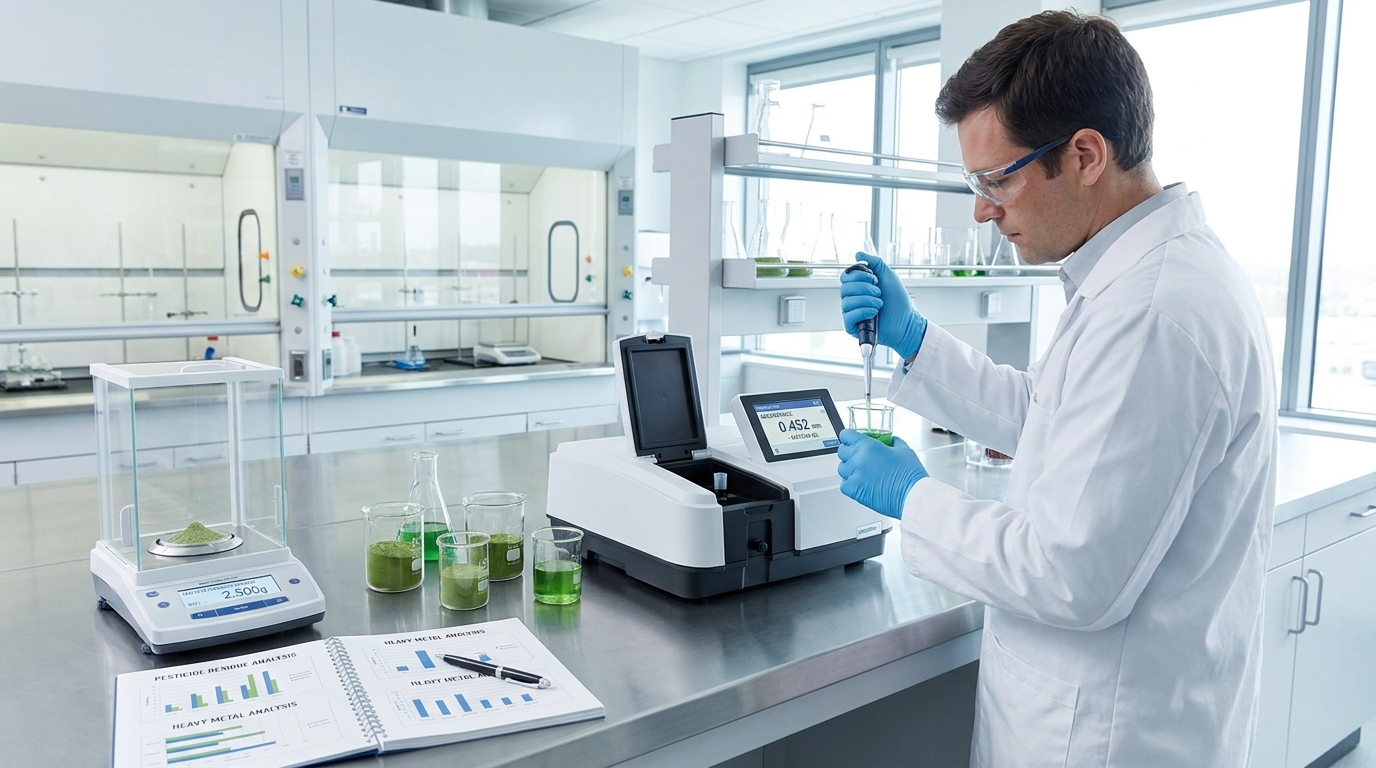
Quality Control Laboratories and Analytical Equipment
A world-class manufacturing facility maintains an on-site quality control lab to test every batch of raw and packaged product. This testing helps verify that your private-label matcha meets all safety and quality standards before it leaves the factory.
Key laboratory testing equipment and testing protocols include:
- High-Performance Liquid Chromatography (HPLC): Used to measure exact levels of L-theanine, caffeine, and catechins (EGCG).
- Moisture Balances: Measures loss-on-drying parameters to ensure moisture levels remain under 5.0%.
- Inductively Coupled Plasma Mass Spectrometry (ICP-MS): Tests for trace heavy metals (such as Lead and Cadmium) to ensure full compliance with target-market food safety regulations.
Contamination Prevention: Metal Detection and Air Filtration (HEPA)
Because tea is an agricultural crop grown outdoors, processing facilities must use strict measures to prevent foreign matter contamination:
- HEPA-Filtered Cleanrooms: Packaging zones operate under positive air pressure and use Class 100,000 HEPA filtration systems to prevent airborne dust, mold spores, and microbial contaminants from entering the product.
- Rare-Earth Magnets: High-intensity inline magnets screen the incoming powder to catch any trace metallic impurities before milling and packing.
- Inline X-Ray Sorters: Automated X-ray inspection systems screen finished, sealed packages on the conveyor line to identify and reject any units containing foreign particles.
14: Private Label Custom Blending and Flavoring
As the matcha market matures, many brands are using custom formulations, flavor profiles, and functional blends to stand out on retail shelves.
Developing Custom Formulations
Adding functional ingredients to matcha helps brands appeal to specific consumer groups, such as fitness enthusiasts or wellness-focused shoppers:
- Matcha Latte Mixes: Combining beverage-grade matcha with sweetening agents (such as organic cane sugar or coconut palm sugar) and milk powders (dairy, oat, or coconut) to create an easy, instant drink mix.
- Functional Nootropic Blends: Blending ceremonial matcha with functional mushrooms (like Lion’s Mane or Cordyceps), Ashwagandha, or L-Theanine to target cognitive focus and sustained energy.
- Beauty & Collagen Blends: Combining jade-grade matcha with marine collagen peptides and biotin to target the nutricosmetics and beauty-from-within market.
Natural Flavoring Sourcing and Homogenization Challenges
- Powder Homogenization: Because matcha particles are exceptionally small and light (5 to 10 microns), they can easily separate from heavier, larger ingredients (such as cane sugar crystals or dense collagen powders) in the package. To prevent this separation, manufacturers use specialized micro-milling and ribbon-blending techniques to ensure a uniform, consistent mix.
- Sourcing Spray-Dried Natural Flavors: When adding fruit flavors (like peach, blueberry, mango, or strawberry), choose spray-dried natural powder flavors with a small particle size to ensure the finished drink dissolves smoothly and retains a balanced taste.
Sweetener Profiles: Sugar, Stevia, Monk Fruit, and Erythritol
Choosing the right sweetener depends on your target market and labeling goals:
- Cane Sugar & Coconut Sugar: Popular for classic, rich café latte mixes. These options offer excellent taste but increase the calorie count on the nutrition panel.
- Stevia (Rebaudioside A): A popular zero-calorie natural sweetener. Use in moderation to avoid a bitter, lingering metallic aftertaste.
- Monk Fruit (Mogroside V) & Erythritol Blends: This combination provides a clean, sugar-like sweetness with zero calories and zero net carbs, making it highly attractive for Keto and low-glycemic lifestyles.
15: The Private Label Production Workflow
Moving from a signed contract to a finished, retail-ready product requires careful coordination across multiple departments.
Production Phases and Critical Path Milestones
This step-by-step table outlines the timeline, responsibilities, and key milestones involved in a standard private label production run:
Phase | Est. Timeline | Key Operational Step & Milestone | Responsible Parties |
|---|---|---|---|
Phase 1: Sampling | Weeks 1 – 2 | Define target flavor profile, grade, and certification requirements. Supplier prepares and ships physical samples for evaluation. | Brand Sourcing Team + Supplier R&D |
Phase 2: Artwork | Weeks 3 – 4 | Brand team designs packaging artwork using supplier-provided templates. Supplier reviews artwork to verify printing compliance. | Brand Designer + Supplier Pre-press Team |
Phase 3: Sourcing | Weeks 5 – 6 | Brand issues first Purchase Order (PO). Brand pays initial deposit. Supplier schedules milling runs and orders raw packaging materials. | Brand Procurement + Supplier Planning |
Phase 4: Production | Weeks 7 – 8 | Tencha is freshly milled. Powder is blended, nitrogen-flushed, and packaged. Samples from the batch are submitted to the lab for COA testing. | Supplier Production & QC Teams |
Phase 5: Release | Week 9 | Lab results confirm purity. Quality control team releases the batch. Brand pays outstanding balance, and goods are prepared for shipping. | Supplier Logistics + Brand Finance |
Phase 6: Logistics | Weeks 10 – 14 | Goods are loaded into temperature-controlled shipping containers. Documents clear export customs and arrive at the destination port. | Freight Forwarder + Customs Broker |
Quality Assurance Hold Points and Batch Release Protocols
To protect product quality and ensure safety, the factory maintains strict quality assurance hold points throughout the production process:
- Raw Material Testing: Tencha lots are screened for heavy metals and pesticide residues before they enter the milling room. Any lot that fails to meet specifications is immediately rejected.
- Inline Sorter Screening: The milled powder is passed through magnetic and electrostatic sorters to remove foreign matter before packaging.
- Finished Goods Testing: Samples from every finished batch are tested for moisture, yeast, mold, and pathogens. The batch is held in the warehouse and is not released for shipping until the laboratory issues a compliant Certificate of Analysis (COA).
16: Supply Chain Logistics and Landed Cost Economics
As an imported agricultural product, shipping matcha requires careful temperature control and a clear understanding of landing costs.
Shipping Protocols: Temperature-Controlled Freight (Reefer Containers)
Matcha is highly sensitive to heat and humidity. Shipping under standard dry container conditions (dry vans) can expose the product to temperatures exceeding 50°C during ocean transit, especially in tropical waters or during summer months. This extreme heat can yellow the powder and degrade its flavor before it arrives.
To prevent degradation:
- Refrigerated Containers (Reefer Containers): For large sea shipments, always ship in reefer containers kept at a constant temperature of 2°C to 5°C.
- Air Freight for Premium Grades: For high-end ceremonial grades or urgent product launches, ship via air cargo to minimize transit time and protect delicate quality.
- Desiccants & Oxygen Absorbers: Include food-grade desiccants and oxygen absorbers in shipping boxes and retail pouches to prevent moisture absorption and oxidation.
Incoterms and Customs Clearance Strategies
- FOB (Free On Board) vs. CIF (Cost, Insurance, and Freight): Buyers should purchase on FOB terms to maintain control over freight rates, routing, and transit times.
- HS Code Classification: Ensure your customs broker uses the correct harmonized tariff classification code to avoid import delays and tariff penalties. Green tea powder (Camellia sinensis) is typically classified under HS Code 0902.10 (Green tea, unfermented, in immediate packings of <= 3kg) or 0902.20 (Green tea, unfermented, in immediate packings of > 3kg).
- Customs Inspections: Keep all documents, including phytosanitary certificates, organic transaction certificates, and COAs, organized and readily available to ensure smooth customs clearance.
Landed Cost Modeling
Understanding your true landed cost is essential for setting profitable retail prices. Use the model below to calculate your final costs:
Landed Unit Cost = (FOB Unit Cost + Unit Ocean Freight + Customs Duties + Port Handling Fees + Domestic Transport) / Total Shipped Units
The table below provides a detailed breakdown of a sample landed cost calculation for an import shipment of 10,000 units of 100g organic retail pouches:
Sourcing Cost Category | Cost Calculation Parameters | Total Cost ($ USD) | Cost Per Unit ($ USD) | Percentage of Total COGS |
|---|---|---|---|---|
FOB Manufacturing Cost | 10,000 units packed in custom pouches @ $1.85 / unit | $18,500.00 | $1.85 | 78.4% |
Ocean Reef Container Freight | LCL chilled reefer sea freight from origin port to US destination | $2,200.00 | $0.22 | 9.3% |
Import Duties & Tariffs | Applied tariff rate (e.g., 6.4% of FOB value) | $1,184.00 | $0.12 | 5.0% |
Customs Brokerage & Clearance | Entry filing fees, bond fees, and delivery order fees | $450.00 | $0.05 | 2.1% |
Port Handling & Terminal Fees | THC, security fees, and container handling charges | $650.00 | $0.07 | 2.8% |
Domestic Ground Freight | Chilled trucking from port warehouse to brand fulfillment center | $600.00 | $0.06 | 2.4% |
Total Landed Sourcing Cost | Comprehensive Landed Costs (DDP Terms) | $23,584.00 | $2.36 | 100.0% |
17: Warehousing, Shelf Life, and Inventory Management
Proper storage is key to maintaining quality and extending the shelf life of your finished products.
Climate-Controlled Storage Parameters (Temperature, Humidity, Light)
To prevent flavor loss and color fading, store finished products in a climate-controlled warehouse that meets these environmental standards:
- Temperature: Store bulk inventory and finished goods at a constant temperature of 15°C or lower (refrigerated storage at 2°C to 5°C is ideal for maximum freshness).
- Relative Humidity (RH): Keep relative humidity under 50% to prevent moisture absorption through paper-based or cardboard packaging.
- Light Protection: Store all boxes and containers away from direct sunlight, UV light, and heat-generating equipment.
Maximizing Shelf Life and Mitigating Oxidation
- Nitrogen-Flushed Packaging: Helps extend the shelf life of unopened packaged matcha up to 2 years from the date of milling.
- Oxygen Absorbers: Placing food-grade oxygen absorbers in stand-up pouches help absorb any oxygen that enters after sealing, helping preserve fresh taste and color.
- Once Opened advice: Educate retail consumers and café staff to seal the packaging tightly and store it in the refrigerator after opening, consuming it within 30 to 60 days for optimal quality.
Minimum Stock Safety Levels and Inventory Reorder Calculations
Because matcha has a 1-year to 2-year shelf life and shipping from origin can take months, brands must use structured inventory models to avoid stockouts:
- Lead Time Demand (LTD): If your monthly sales average 2,500 units and the total lead time (milling, packing, and shipping) is 3 months, your lead time demand is 2,500×3=7,5002,500 \times 3 = 7,500
units.
- Safety Stock (SS): Maintain a 1-month to 2-month safety stock (e.g., 5,000 units) to cover shipping delays or sudden increases in sales.
- Reorder Point (ROP): Calculate your reorder point using this standard formula:
In this example, the reorder point is
7,500+5,000=12,5007,500 + 5,000 = 12,500
units. When inventory drops to this level, place your next order immediately to ensure continuous supply.
18: Strategic B2B Sales Channels and Marketing
A successful launch requires matching your product grade, packaging, and pricing to your target sales channels.
Penetrating Retail Channels: Supermarkets, Specialty Stores, and Cafés
- Multi-Unit Café Chains: Focus on providing highly soluble, sweetened portion-controlled latte mixes or bulk culinary grades. Ensure you can guarantee consistent quality and steady pricing to support their high volume needs.
- Supermarkets & Natural Food Chains: Focus on providing USDA/EU organic certified premium ceremonial and culinary grades in retail pouches or tins. Highlight certifications like non-GMO, gluten-free, kosher, and organic to stand out on grocery shelves.
- E-Commerce & Amazon DTC Brands: Focus on attractive, eye-catching packaging design and clear, educational product listings. Highlighting quality markers, origin details, and preparation tips helps build trust with online shoppers.
Multi-Channel Distribution Strategies
The table below compares the typical pricing, sales volumes, and marketing focuses of the main distribution channels:
Sales Channel Type | Key Decision Maker | Typical Sourcing Volume | Expected Pricing Model | Key Brand Marketing Focus |
|---|---|---|---|---|
Grocery Retailers | Category Merchant / Grocery Buyer | High Volume (FCL shipments, pallet-level distribution) | Distributor Cost (Wholesale margin 30% – 45%) | Certifications (Organic, Kosher), shelf appeal, eco-packaging |
Beverage chains / Cafés | Beverage Director / Franchise Owner | Medium-High Volume (Steady weekly/monthly deliveries) | Contract Pricing (Bulk pricing per kg or portion pack) | Mixing speed, taste consistency in milk, competitive cost-per-cup |
Specialty Wellness Retailers | Store Manager / Lead Sourcing Agent | Medium Volume (Case-level ordering) | Boutique Wholesale (Margin 40% – 50%) | Farm origin stories, clean labels, high active compounds |
Direct-to-Consumer (E-comm) | Digital Brand Owner / Growth Marketer | Granular, highly variable (Individual unit orders) | Direct Retail (Maximum margin, up to 70%+) | Aesthetic lifestyle photos, clear brewing videos, user reviews |
Positioning as a Premium Brand vs. Value Brand
- Premium Brand Strategy: Highlight traditional Japanese origins (such as Uji or Kagoshima), spring harvests, stone milling, and complex flavor profiles. Package in high-end metal tins with minimalist designs to support premium, high-margin pricing.
- Value Brand Strategy: Focus on modern, highly efficient organic farming regions, jet milling, and versatile culinary applications. Package in larger, resealable pouches to appeal to value-conscious consumers looking for daily green tea and smoothie options.
To capture the profitable food service market, brands focus on supplying Culinary Matcha Powder designed specifically for smooth mixing and bold color in lattes and baking.

19: Regulatory Compliant Labeling and Marketing Claims
To avoid regulatory issues and potential product seizures, your retail packaging labels must comply with all target-market regulations.
FDA, EFSA, and Local Labelling Laws
- FDA Labeling Requirements (United States): Labels must include the common name of the food (“100% Matcha Green Tea Powder” or “Matcha Green Tea”), a net weight statement in both ounces and grams, a compliant Nutrition Facts panel, an ingredient statement, and the name and address of the manufacturer, packer, or distributor.
- EFSA Regulations (European Union): Labels must comply with EU food labeling regulations, listing net weight in metric units, country of origin, and an organic logo with the certifier’s code number (e.g., JP-BIO-005) when claiming organic status.
Managing Nutrition Facts Panels and Ingredient Statements
- Ingredient Declaration: Pure matcha must be labeled as “100% Green Tea Powder” or “Matcha Green Tea Powder”. Custom formulations must list all ingredients in descending order of weight (e.g., “Organic Cane Sugar, Matcha Green Tea Powder, Natural Peach Flavor”).
- Allergen Disclosures: If the factory processes allergens (like soy, milk, or tree nuts) on the same packaging line, include a “May Contain” warning to manage risk and protect consumers.
Health Claims, Functional Claims, and Trademark Registration
- Authorized Health Claims: Avoid claiming that your product can prevent, treat, or cure any disease (e.g., “Matcha cures cancer”). Such statements can result in warning letters and product seizures from regulatory authorities.
- Allowed Functional Claims: You can use supported functional and structural claims, such as “supports energy and focus,” “high in natural antioxidants,” or “promotes calm energy.”
- Trademark Registration: Protect your brand name, logo, and unique product designs by registering trademarks in your target sales countries early in the development cycle.
20: Troubleshooting Common Production and Supply Chain Failures
An experienced supply chain manager must anticipate and know how to address common production and quality challenges.
Quality Issues: Color Degradation, Clumping, and Sensory Defects
- Issue: Matcha turns yellow or brown over time.
- Root Cause: Moisture levels are too high (above 5.5%), packaging has a poor oxygen barrier, or the product is stored in high temperatures.
- Solution: Use multi-layer aluminum foil packaging with a nitrogen flush during filling, and store inventory in a cold, dry warehouse below 15°C.
- Issue: Powder is clumping in the package.
- Root Cause: The powder has picked up moisture from the air, or was not sifted properly before packing.
- Solution: Include food-grade desiccants or silica gel packs in your packaging, and use fine sifting screens during production.
- Issue: Bitter, astringent taste in a ceremonial product.
- Root Cause: Low-quality summer or autumn harvests were used, or the milling speed was too fast, creating friction heat.
- Solution: Verify that the raw material is 100% first-flush spring harvest, and require the mill to log and control temperatures under 35°C.
Operational Bottlenecks: Customs Delays, Port Congestion, and Packaging Defectives
- Issue: Import shipment is held by customs.
- Root Cause: Incomplete or incorrect paperwork (such as missing organic transaction certificates or phytosanitary certificates).
- Solution: Work with an experienced customs broker to review and prepare all documentation before the shipment arrives at the port.
- Issue: Pouches are leaking along the side seals.
- Root Cause: Fine matcha powder got trapped in the heat-seal zone of the pouch during high-speed filling, weakening the seal.
- Solution: Use anti-static systems and vacuum nozzles to keep the seal zone clean during packaging, and perform daily seal-strength tests on the production line.
Crisis Management: Product Recalls and Traceability Execution
If a batch fails a safety test or shows contamination, activate your recall plan immediately:
- Traceability Mapping: Use your batch codes and shipping records to identify and locate every unit from the affected run.
- Coordinated Communications: Notify all affected retail partners, distributors, and regulatory agencies, providing clear instructions for identifying and removing the product.
- Corrective Action Plans: Work closely with your manufacturer to investigate the issue, identify the root cause, and implement changes to prevent it from happening again.
21: The 90-Day Go-To-Market and Launch Plan
A structured launch plan helps manage tasks, coordinate teams, and ensure a successful product launch.
Executing the Phase-Gate Launch Process
The 90-Day Launch Plan below outlines the key tasks, timelines, and success metrics for launching your private-label matcha product:
Timeline | Phase Focus | Key Tasks & Actions | Success Metrics & Outputs |
|---|---|---|---|
Days 1 – 30 | Sourcing & Formulations | Request and evaluate samples. Submit samples to labs for testing. Finalize formulation and grade. Select packaging size and format. | Signed supply agreement; finalized formulation; confirmed target COGS. |
Days 31 – 45 | Design & Compliance | Design packaging artwork. Supplier reviews artwork for printing. Finalize nutrition facts panels. Register trademarks and barcodes. | Approved artwork files; registered UPC codes; approved compliance labels. |
Days 46 – 60 | Production & Logistics | Issue first PO and pay deposit. Supplier schedules milling and printing runs. Arrange ocean or air shipping. Prepare customs paperwork. | Production run completed; lab-verified COA issued; customs entry filed. |
Days 61 – 75 | Warehousing & Setup | Prepare climate-controlled storage space. Setup retail and e-commerce listings. Create marketing materials and product photography. | Inventory received and checked; retail listings active; marketing assets ready. |
Days 76 – 90 | Launch & Distribution | Ship inventory to retail partners. Launch online advertising and promotions. Collect initial sales data and monitor customer feedback. | Initial orders fulfilled; marketing campaigns active; first sales data logged. |
To manage and organize this timeline, brands utilize a dedicated planning space to coordinate logistics, packaging, and marketing launches.
22: Comprehensive B2B Private Label Matcha FAQ & Inquiries
17 High-Value Industry FAQs
Q1: What is the typical Minimum Order Quantity (MOQ) for a private label matcha project?
Standard MOQs for low-MOQ programs using blank stock tins or pouches with custom printed paper labels usually start at 1,000 to 2,000 units. For fully customized packaging (such as direct-lithograph printed metal tins or custom-printed rotogravure barrier film pouches), the MOQ typically starts at 10,000 to 20,000 units due to industrial printing press setup requirements.
Q2: What is the difference between ceremonial and culinary grade matcha in terms of sourcing cost?
Sourcing costs vary widely based on harvest and quality. Bulk culinary grades (used for baking and industrial food production) typically range from
10.00to10.00 to
20.00 per kilogram. Premium culinary and café-grade matcha averages
20.00to20.00 to
40.00 per kilogram. Authentic, first-flush spring ceremonial grades range from
60.00toover60.00 to over
150.00 per kilogram, depending on the cultivar, origin, and hand-picking processes.
Q3: How long does a typical private label production run take from PO to shipping?
Initial production runs, including custom packaging printing and artwork proofing, typically take 6 to 8 weeks from purchase order and deposit receipt. Repeat orders using pre-printed packaging materials are much faster, usually completed within 3 to 4 weeks.
Q4: Why is nitrogen flushing critical in the packaging process?
Matcha is highly sensitive to oxygen. Nitrogen flushing removes oxygen from the container and replaces it with nitrogen, keeping the oxygen level below 2.0%. This prevents oxidation, protects the bright green color, preserves delicate flavors, and extends the shelf life up to 2 years.
Q5: Can I import organic matcha directly with USDA or EU Organic claims?
Yes, but the entire supply chain must maintain organic certification. Your supplier’s facility must hold a valid organic certificate (such as JAS, USDA, or EU Organic), and you must secure organic Transaction Certificates (TCs) for every shipment to maintain the organic claim on your labels.
Q6: What heavy metal limits should I specify in my sourcing contracts?
To comply with global food safety standards, ensure your contracts specify lead (Pb) levels under 1.0 ppm, arsenic (As) under 1.0 ppm, and cadmium (Cd) under 0.1 ppm. Always require an independent, batch-specific ICP-MS heavy metal test report.
Q7: How does jet milling compare to traditional stone milling?
Traditional granite stone milling is very slow (30g – 40g per hour) but keeps temperatures low, producing round-edged particles (5-10 microns) ideal for luxury ceremonial matcha. Jet milling uses compressed air to grind at a high scale (50kg – 200kg+ per hour), producing fine, uniform particles perfect for café and retail grades.
Q8: What are the main shipping requirements for ocean freight?
Always ship large volumes of matcha in refrigerated containers (reefer containers) kept at 2°C to 5°C. Keep relative humidity under 50%, and include desiccants and oxygen absorbers in shipping boxes to protect the powder from heat and moisture during transit.
Q9: Can I add custom flavors and functional ingredients to my private label matcha?
Yes. Many brands create custom formulations, such as sweet café latte mixes, collagen blends, or functional nootropics (adding ingredients like Lion’s Mane mushroom or L-theanine). Ensure your manufacturer uses micro-milling and ribbon blenders to prevent ingredients from separating in the package.
Q10: What regulatory information must be included on my retail label?
Your retail label must include the common name of the product, net weight in both metric and imperial units, a compliant Nutrition Facts panel, an ingredient statement, country of origin, and the name and address of the manufacturer, packer, or distributor.
Q11: How long is the shelf life of unopened, packaged matcha?
Unopened matcha packed in high-barrier aluminum packaging with a nitrogen flush typically has a shelf life of 2 years from the date of milling. Once opened, it should be stored in the refrigerator and consumed within 30 to 60 days for optimal freshness.
Q12: How do I calculate my safety stock and reorder points?
Calculate your safety stock based on monthly sales and shipping times. Your reorder point is calculated by adding your lead time demand (sales volume during the time it takes to produce and ship a new order) to your safety stock level.
Q13: What micro-biological standards must my private label matcha meet?
For dry green tea powder, the standard micro-biological safety limits are: Total Plate Count (TPC) under 10,000 CFU/g, Yeast & Mold under 100 CFU/g, and Negative results for pathogens like E. coli and Salmonella.
Q14: Why do some organic matcha powders look less vibrant than conventional grades?
Organic farming relies on slow-release organic fertilizers (like compost or oil cakes) rather than fast-acting chemical nitrogen. This can sometimes result in slightly lower chlorophyll levels, making the powder look a bit less vibrant than conventional grades grown with synthetic fertilizers.
Q15: How can I prevent my custom formulations from separating in the packaging?
Because matcha has a very small particle size (5-10 microns), it can easily separate from heavier ingredients. Work with your manufacturer to use micro-milled ingredients of similar density, and use specialized ribbon blenders to ensure a uniform, stable mix.
Q16: What is the risk of using standard dry containers (dry vans) for shipping?
Standard dry containers can reach temperatures above 50°C during ocean transit. This extreme heat degrades chlorophyll and oxidizes the tea leaves, turning the premium green powder brown and giving it a stale flavor before it arrives.
Q17: What are the most common reasons for customs clearance delays?
The most common causes of delays are incomplete or incorrect documentation, such as missing phytosanitary certificates, incorrect HS tariff classifications, or inconsistent batch numbers between the COA and shipping invoices.
Start Your Private Label Matcha Project
Are you ready to develop a highly profitable, premium private label matcha line with a globally certified, farm-direct partner? The expert team at Riching Matcha is here to assist you at every step—from sourcing first-flush ceremonial grades to developing custom functional formulations and premium packaging.
To take the next step in your procurement journey, Inquire with our B2B experts to request a comprehensive product catalog and custom quote.
Request Your Sample Evaluation Kit Today
To help us provide the most accurate quote and tailored samples, please prepare the following details before reaching out to our team:
- Target Matcha Grade: (e.g., Organic Ceremonial, Premium Café Grade, Culinary Ingredient Grade)
- Target Packaging Format: (e.g., 30g Metal Tin, 100g Stand-Up Pouch, 1.5g Stick Packs, or Bulk 10kg Sacks)
- Estimated First Order Volume: (e.g., 1,000 units, 5,000 units, or 1,000 kg bulk)
- Required Certifications: (e.g., USDA Organic, EU Organic, Kosher, Halal, FSSC 22000)
Contact Riching Matcha:
- Corporate Email: laura@richingmatcha.com
- Wholesale WhatsApp & Mobile: +86 18660258415
- Primary Processing Facility Address: Yuhang, Hangzhou City, Zhejiang Province, China