
1. What Is a Matcha COA and Why Does It Matter for B2B Buyers?
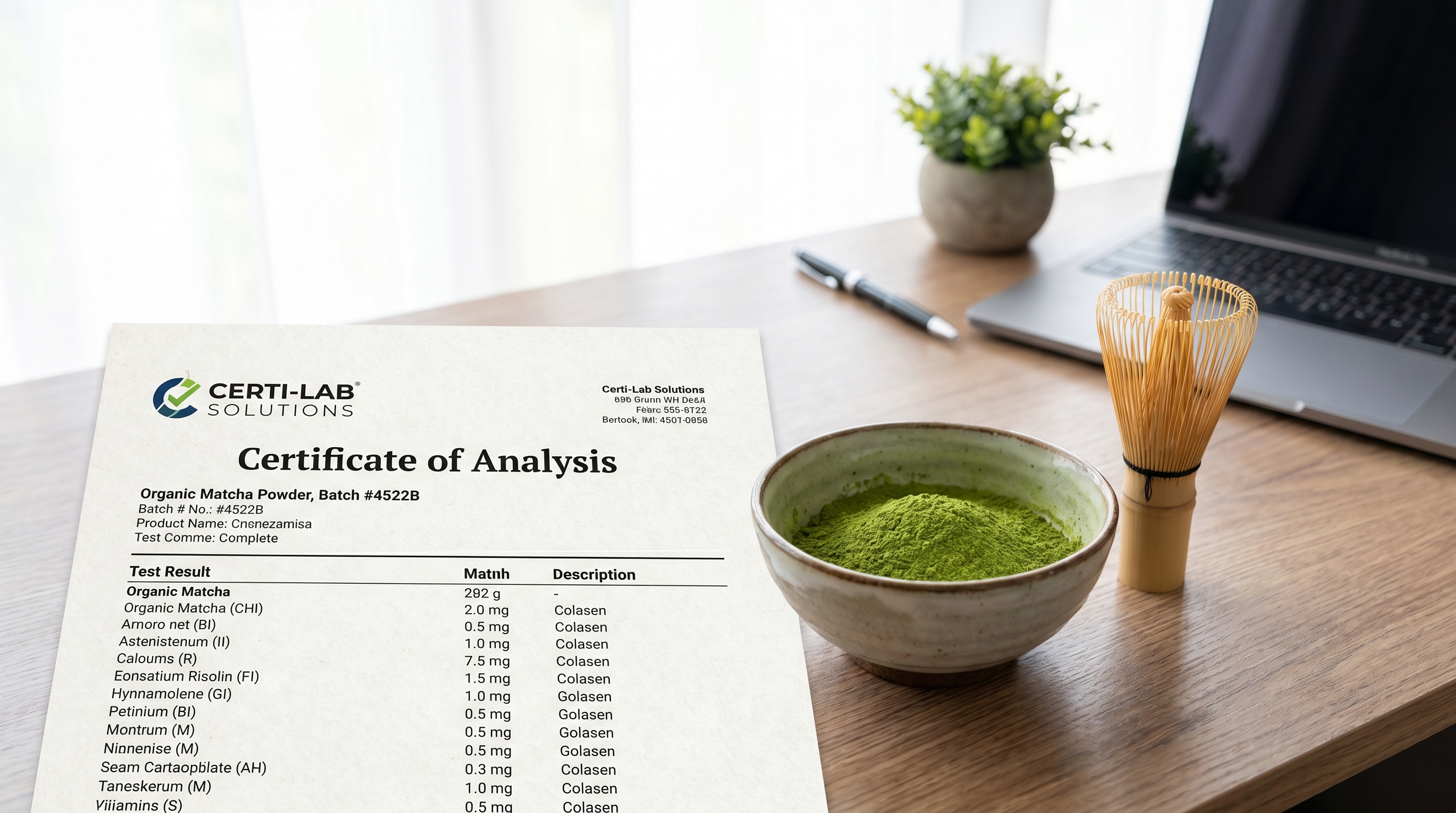
A Certificate of Analysis, usually called a COA, is one of the most important quality documents a B2B matcha buyer should review before placing a bulk order. In simple terms, a matcha COA is a laboratory or factory-issued document that summarizes the tested quality and safety results of a specific batch of matcha powder.
For buyers, the COA helps answer several practical questions: Is this batch safe for import? Does it meet the expected quality level? Are the test results linked to the actual product being shipped? Does the supplier have a transparent quality control system?
A COA is especially important for importers, food manufacturers, tea brands, cafés, beverage chains, and private label matcha companies. When you buy matcha in small retail packs, you may focus mainly on flavor and color. But when you buy 20 kg, 100 kg, 500 kg, or several tons, the risk becomes much bigger. A wrong batch can lead to failed customs clearance, delayed product launch, customer complaints, or even product recall.
A strong COA should usually include the product name, batch number, production date, testing date, test items, testing methods, results, acceptable limits, laboratory information, and signature or authorization. However, not all COAs are equally reliable. Some COAs are complete and batch-specific, while others are too simple, outdated, or not connected clearly to the product being offered.
For B2B buyers, reading a matcha COA is not about becoming a food scientist. It is about knowing which details matter, which questions to ask, and which red flags require further checking. This guide explains how to read the most common sections of a matcha COA and how to use the document as part of a practical supplier evaluation process.
If you are still selecting grades before reviewing documents, you can also compare applications on Riching Matcha’s Premium Grade Matcha page.
2. Check the Supplier, Lab, Date, Batch Number, and Report Authenticity First

Before reading the technical numbers, start with the basic identity information. Many buyers immediately look for heavy metals or pesticide results, but the first question should be: “Does this COA actually belong to the matcha batch I am buying?”
A useful COA should clearly identify the product. The product name should match the quoted product, such as ceremonial grade matcha, premium grade matcha, culinary grade matcha, organic matcha powder, or matcha latte powder. If the quotation says “TOP ceremonial matcha” but the COA says only “green tea powder,” you should ask the supplier to clarify whether the report is truly for the same product.
The batch number is also critical. In B2B trade, documents should connect together: quotation, proforma invoice, packing list, product label, COA, pesticide report, and shipping documents. If the COA batch number is different from the production batch shown on the packaging, the buyer cannot confidently prove traceability.
The testing date and production date also matter. A report from several years ago may show that a supplier once tested a product, but it does not prove the current batch meets the same standard. For long-term cooperation, buyers should ask whether the supplier can provide batch-specific COAs or at least recent test reports for the same grade and production lot.
The laboratory information should also be reviewed. A third-party laboratory report generally gives buyers more confidence than a very simple internal document. However, internal COAs can still be useful when they are supported by clear quality control procedures and external test reports when required.
| COA Detail to Check | Why It Matters | Buyer Action |
|---|---|---|
| Product name | Confirms the COA matches the quoted matcha grade | Compare with quotation and invoice |
| Batch number | Links the report to the actual shipment | Match with label and packing list |
| Testing date | Shows whether the report is recent | Ask for updated report if too old |
| Lab name | Helps evaluate credibility | Request third-party report if needed |
| Signature or stamp | Shows authorization | Check if the report looks complete |
| Report number | Helps trace the document | Ask supplier to verify if uncertain |
A reliable supplier should not avoid document questions. If a supplier becomes defensive when you ask about batch numbers, original reports, or testing dates, that is a warning sign.
3. Sensory Quality: Appearance, Color, Aroma, Taste, and Application Fit

A COA often focuses on technical safety data, but B2B buyers should not ignore sensory quality. Matcha is not just a regulated food ingredient; it is also a product judged by color, aroma, flavor, mouthfeel, and performance in drinks or food production.
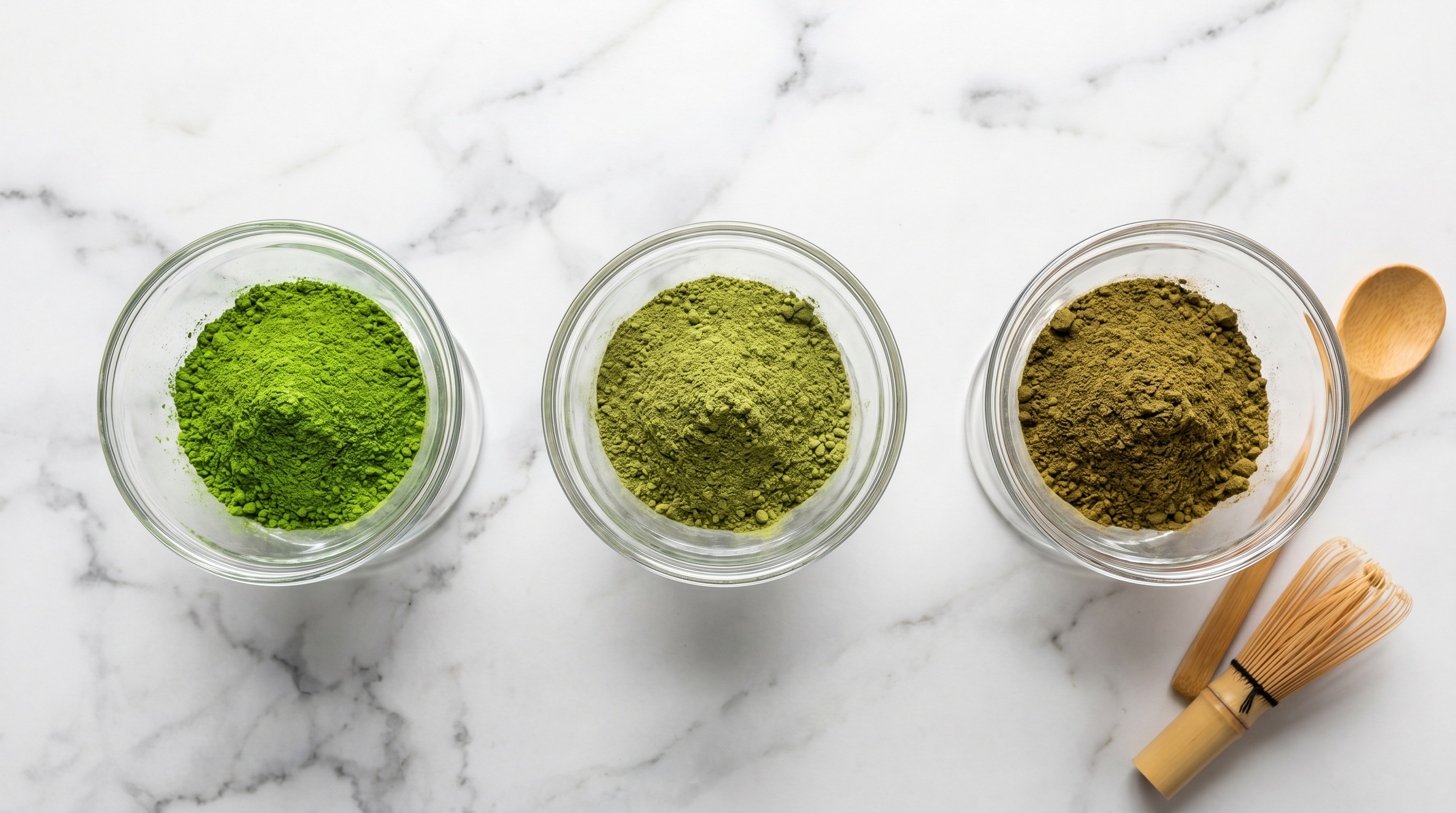
The appearance section of a COA or specification sheet may describe the powder as fine, uniform, bright green, yellow-green, or dark green. Color is one of the fastest ways for buyers to judge whether a matcha grade fits their market. For premium drinking matcha, buyers usually expect a vivid green color and smooth powder texture. For bakery or food processing, the color may be slightly less vivid, but it still needs to remain stable during production.
Aroma is another important factor. Good matcha should have a fresh, grassy, seaweed-like, or umami aroma depending on grade and origin. Stale, smoky, sour, dusty, or hay-like notes may suggest poor storage, oxidation, low-grade raw material, or old stock.
Taste should be evaluated according to application. Ceremonial matcha for direct drinking should be smoother, more umami, and less bitter. Premium matcha for lattes should remain balanced when mixed with milk or plant-based milk. Culinary grade matcha should have stronger flavor and color performance in bakery, desserts, smoothies, or food processing.
| Sensory Item | What Buyers Should Look For | Possible Problem |
|---|---|---|
| Color | Bright green to natural green depending on grade | Dull, brownish, or grey color |
| Aroma | Fresh, vegetal, clean, pleasant | Stale, smoky, sour, dusty |
| Taste | Suitable bitterness, umami, clean finish | Harsh bitterness or unpleasant aftertaste |
| Texture | Fine powder, smooth mixing | Gritty powder, visible particles |
| Application | Performs well in intended use | Good in water but weak in latte, or vice versa |
The COA alone cannot replace sample testing. Buyers should always test matcha in the real application: hot water, iced latte, bubble tea, smoothie, bakery, chocolate, ice cream, or protein blend. For cafés and beverage brands, reviewing Riching Matcha’s guide on where cafés buy matcha in bulk can also help connect COA review with real menu performance.
4. Moisture Content: Why It Affects Shelf Life, Color, and Flowability
Moisture content is one of the most practical COA indicators for matcha powder. Matcha is finely ground, which means it has a large surface area and can absorb moisture more easily than loose tea leaves. If the moisture level is too high, the powder may become clumpy, lose freshness faster, change color, or become more vulnerable to microbiological problems.
For B2B buyers, moisture content affects both storage and production. In retail packaging, high moisture can reduce shelf life and create a poor customer experience after opening. In café or factory production, moisture can affect flowability, dosing accuracy, mixing performance, and powder handling.
A COA may show moisture as a percentage. The acceptable range may vary depending on supplier specification, market requirements, and product type. Instead of focusing only on one fixed number, buyers should ask whether the moisture result meets the supplier’s own specification and whether the packaging is suitable for the shipment route and storage conditions.
Matcha is sensitive to oxygen, light, heat, and humidity. Even a qualified batch can degrade if it is packed poorly or stored incorrectly. This is why COA review should be combined with packaging review. Bulk matcha is usually better protected with sealed inner bags, foil bags, cartons, or drums depending on the order size and transport method.
| Moisture-Related Question | Why It Matters |
|---|---|
| Is the moisture result within specification? | Helps judge shelf-life stability |
| Is the matcha packed in moisture-resistant packaging? | Reduces risk during long-distance shipping |
| Is the storage instruction clear? | Helps buyer maintain quality after arrival |
| Is the powder clumpy during sample testing? | May indicate moisture exposure |
| Is the production date recent? | Helps estimate remaining freshness |
Buyers should also confirm storage recommendations. In general, unopened matcha should be stored in a cool, dry place away from direct light and strong odors. After opening, it should be sealed tightly and used as soon as possible, especially for high-grade matcha where color and aroma are key selling points.
5. Microbiological Results: What Importers, Cafés, and Food Brands Should Check

Microbiological testing is one of the most important safety sections in a matcha COA. Because matcha powder is consumed directly or used in beverages and foods, buyers need to know whether the product meets basic hygiene expectations.
Common microbiological items may include total plate count, yeast and mold, coliforms, E. coli, Salmonella, and sometimes Staphylococcus aureus or other market-specific items. The exact test list depends on the buyer’s destination country, customer requirements, and product application.
For example, a café chain using matcha in lattes may mainly need to ensure the powder is safe for beverage preparation. A food manufacturer using matcha in ready-to-eat products may require stricter documentation. A private label brand selling retail tins may need microbiological results for regulatory files and retailer approval.
When reading this section, buyers should pay attention to both the result and the limit. A result is meaningful only when it is compared with an acceptable standard. If a COA says “pass” but does not show test items, methods, or limits, it is less useful for serious B2B evaluation.
| Microbiological Item | What It Indicates | Buyer Concern |
|---|---|---|
| Total plate count | General microbial load | Overall hygiene and handling |
| Yeast and mold | Risk from storage or moisture | Shelf life and product stability |
| Coliforms | Hygiene indicator | Processing and handling control |
| E. coli | Food safety concern | Possible contamination |
| Salmonella | Serious pathogen risk | Import and food safety risk |
Buyers should also ask whether the product has been tested according to the requirements of their target market. Different countries, retailers, and food manufacturers may have different internal standards. A qualified result for one customer may not automatically satisfy another.
A professional supplier should be able to explain the microbiological section clearly. If the supplier only says “don’t worry, no problem” but cannot provide the report, method, or batch information, the buyer should request stronger documentation before ordering.
6. Heavy Metals in Matcha: Lead, Arsenic, Cadmium, and Mercury

Heavy metals are among the most important safety concerns for matcha buyers. Matcha is made from whole ground tea leaves, so buyers are often more careful with contaminant testing than they might be with brewed tea. The four heavy metals most commonly reviewed are lead, arsenic, cadmium, and mercury.
A COA should show the test result for each heavy metal and the corresponding limit or specification. The result may be shown as “not detected,” “below limit,” or as a measured value. Buyers should avoid assuming that “organic” automatically means “free from heavy metals.” Organic certification focuses mainly on agricultural and processing standards, while heavy metals are environmental contaminants that still require testing.
Heavy metal limits can vary by market, product category, and customer standard. Therefore, B2B buyers should check both regulatory requirements and their own customer’s internal limits. This is especially important for brands selling to supermarkets, health food stores, Amazon, beverage chains, or infant-related product categories where standards may be stricter.
| Heavy Metal | Why Buyers Check It | Practical Buyer Question |
|---|---|---|
| Lead | Common concern in tea and plant products | Is the result within my market’s limit? |
| Arsenic | Environmental contaminant concern | Is inorganic arsenic required by my customer? |
| Cadmium | Soil-related contaminant concern | Is the level acceptable for my product category? |
| Mercury | General contaminant safety check | Is it tested and clearly reported? |
When evaluating heavy metals, buyers should not only ask for a single old report. They should ask how often the supplier tests heavy metals, whether results are batch-specific, and whether the report is from a recognized lab. If the buyer is importing a large quantity, it is reasonable to request updated testing before shipment.
A strong supplier should understand that heavy metal testing is not just paperwork. It is a trust-building tool. Transparent testing helps buyers protect their brand, satisfy customs or retailer review, and reduce risk before committing to a long-term supply agreement.
7. Pesticide Residues: Why Organic Matcha Still Needs Full Testing
Pesticide residue testing is one of the most important sections for international matcha buyers, especially for organic brands, EU importers, North American distributors, and health food companies. Even when matcha is marketed as organic, buyers should still request pesticide residue testing.
Why? Because organic certification and pesticide residue testing are not the same thing. Organic certification shows that the farm and production system follow organic standards. A pesticide residue test shows whether specific chemical residues were detected in a sample. For serious B2B buying, both types of documents may be needed.
A pesticide report may include dozens, hundreds, or even several hundred pesticide items depending on the testing scope. Buyers should review whether the test panel is broad enough for their market. For example, a simple COA that only says “pesticides: pass” is much less useful than a detailed third-party report listing individual pesticide compounds, detection limits, and results.
| Pesticide Report Detail | Why It Matters |
|---|---|
| Number of pesticides tested | Shows how broad the test scope is |
| Detection limit | Shows the sensitivity of the test |
| Individual compound list | Helps customers verify specific concerns |
| Result for each compound | Shows whether residues were detected |
| Lab and report date | Helps confirm credibility and freshness |
| Batch connection | Confirms the report applies to the shipment |
Buyers should also be careful when comparing organic and conventional matcha. Conventional matcha can still be safe if it passes pesticide testing for the target market. Organic matcha can still require verification if the buyer needs proof for importers, retailers, or brand claims.
For private label brands, pesticide testing is especially important because the final consumer sees the brand owner’s label, not the raw material supplier’s name. If a problem occurs, the brand owner may face the customer complaint, not the overseas factory. This is why document review should happen before production, not after the goods arrive.
For buyers building their own retail brand, Riching Matcha’s Private Label Matcha Supplier page can help connect pesticide documentation with packaging, MOQ, and product launch planning.
8. Particle Size, Mesh, and Powder Performance in Drinks and Food Production
Particle size is often overlooked, but it can strongly affect how matcha performs in real production. A COA or specification sheet may mention mesh size, fineness, or particle size. For B2B buyers, this is not just a technical detail. It affects mouthfeel, solubility perception, suspension, mixing speed, foam quality, and final product appearance.
Matcha is not truly dissolved like sugar. It is a fine powder dispersed in water, milk, or other liquid systems. The finer and more uniform the powder, the smoother the drinking experience tends to be. Coarser powder may create a gritty mouthfeel or sediment at the bottom of the cup. However, the best particle size depends on application.
For ceremonial drinking, buyers usually prefer very fine powder with a smooth mouthfeel. For lattes and café beverages, fine powder helps with whisking, shaking, and mixing. For bakery, ice cream, chocolate, or dry blends, particle size must fit the production process and ingredient system.
| Application | Particle Size Priority | Buyer Testing Method |
|---|---|---|
| Pure drinking | Smooth mouthfeel and easy whisking | Whisk with hot water |
| Matcha latte | Good dispersion in milk | Test hot and iced latte |
| Bubble tea | Stable color and no strong sediment | Shake with syrup and milk |
| Bakery | Even color distribution | Bake test in cake or cookies |
| Ice cream | Smooth texture and color stability | Mix into dairy or plant base |
| Powder blend | Flowability and uniform blending | Dry mix test |
Buyers should not judge mesh only by number. A supplier may use mesh descriptions differently, and different grinding methods may create different powder behavior even at similar fineness levels. The safest approach is to test samples in the exact production process.
For beverage brands and food factories, the best COA review combines technical data with application testing. A matcha powder may pass all safety tests but still fail commercially if it tastes too bitter in milk, settles too fast in RTD drinks, or loses color in bakery.
If your main application is food production, you can review Riching Matcha’s Culinary Grade Matcha page for application-oriented grade selection.
9. Batch Number, Traceability, and Document Consistency Across the Order

Traceability is one of the strongest signs of a professional matcha supplier. For B2B buyers, the COA should not exist as an isolated document. It should connect logically with every other document in the order.
A good traceability system links the tea farm or raw material source, production batch, grinding or blending record, packaging date, COA, pesticide report, heavy metal report, invoice, packing list, and shipment documents. When these details match, buyers can more easily satisfy customs, retailers, and internal quality teams.
Traceability becomes especially important when buyers order multiple grades or packaging formats. For example, a shipment may include ceremonial grade in 30 g tins, premium grade in 100 g pouches, and culinary grade in 5 kg bulk bags. Each product should have clear batch identification. If all documents use vague descriptions such as “matcha powder,” it may be difficult to prove which test result belongs to which SKU.
| Document | Information That Should Match |
|---|---|
| COA | Product name, batch number, testing date |
| Pesticide report | Product name, sample ID, report date |
| Heavy metal report | Product name, batch/sample ID |
| Packing list | Product name, net weight, cartons |
| Invoice | Product name, quantity, buyer/seller |
| Product label | Batch number, production date, shelf life |
| Shipping documents | Quantity and product description |
A professional buyer should ask the supplier to confirm document consistency before shipment. It is much easier to correct a document before customs clearance than after goods arrive at the destination port.
Traceability also helps in long-term cooperation. If one batch performs especially well in a café chain or retail market, the buyer can use the batch record to reorder the same or closest possible grade. If there is a complaint, the supplier can investigate more quickly.
For brands developing customized products, Riching Matcha’s OEM Matcha Manufacturing and Private Label Services page is a useful internal link because OEM projects usually require stronger coordination between product specification, packaging, testing, and shipping documents.
10. Common Red Flags in a Matcha COA
A COA can look professional at first glance but still contain serious problems. B2B buyers should know the most common red flags before placing a bulk order.
One major red flag is missing batch information. If the COA does not show a batch number, sample ID, production date, or product grade, it may be impossible to connect the report to the shipment. Another red flag is an outdated report. A very old COA may not represent current production, especially if raw material, harvest season, or processing conditions have changed.
A vague test result is also a problem. For example, “heavy metals: pass” is less useful than a table showing lead, arsenic, cadmium, and mercury results. “Pesticides: qualified” is less useful than a detailed pesticide residue report with tested compounds and detection limits.
Buyers should also watch for inconsistent product names. If the supplier offers organic ceremonial matcha but the COA says conventional green tea powder, that requires clarification. If the COA shows one grade but the invoice shows another, the buyer should not ignore the mismatch.
| Red Flag | Why It Is Risky | What to Ask |
|---|---|---|
| No batch number | Cannot prove traceability | “Can you provide batch-linked COA?” |
| Old report | May not reflect current batch | “Do you have recent testing?” |
| Only “pass/fail” result | Not enough detail for review | “Can you provide full test values?” |
| Product name mismatch | May belong to another product | “Which batch does this report cover?” |
| No lab information | Hard to verify credibility | “Was this internal or third-party tested?” |
| Blurry scan | Could hide missing details | “Can you send original PDF?” |
| Different supplier name | May be reused from another source | “Please explain the relationship.” |
A trustworthy supplier will usually answer these questions calmly and clearly. Serious buyers should not feel embarrassed to ask. In international food trade, document checking is normal business practice.
11. How to Compare COAs from Different Matcha Suppliers Before Ordering
When comparing suppliers, many buyers focus first on price. Price matters, but a low price without reliable documentation can become expensive later. A good supplier comparison should include COA quality, sensory performance, certification support, packaging, communication speed, production capacity, and logistics reliability.
Start by comparing whether each supplier can provide the same document set. If Supplier A provides a recent COA, pesticide report, heavy metal report, organic certificate if required, specification sheet, and clear batch number, while Supplier B only provides a simple one-page COA, the risk level is different.
Next, compare whether the test items match your market. A buyer selling to cafés may mainly need safety, sensory quality, and stable supply. A buyer selling to supermarkets may need stronger documentation, label support, and certification files. A buyer selling private label matcha online may need both consumer-facing quality and backend compliance documents.
| Comparison Factor | Strong Supplier | Risky Supplier |
|---|---|---|
| COA detail | Shows batch, test items, values, limits | Only says “pass” |
| Testing scope | Covers key safety items | Missing pesticide or heavy metals |
| Traceability | Documents match across order | Product names do not match |
| Communication | Explains results clearly | Avoids technical questions |
| Sample consistency | Sample matches bulk order | Bulk differs from sample |
| Packaging | Protects powder during shipment | Weak moisture/light protection |
| Certifications | Valid and relevant to market | Old, unclear, or unrelated certificates |
Buyers should also compare sample performance. A supplier with strong documents but poor flavor may not fit your brand. A supplier with excellent sample flavor but weak documents may create import risk. The best supplier is the one who can support both quality and compliance.
For buyers planning wholesale or long-term distribution, Riching Matcha’s Organic Matcha Wholesale Supplier in Europe page can be used as an internal reference for certification, packaging, logistics, and common buying mistakes.
Before confirming an order, ask each supplier the same questions:
Can you provide a recent COA for this grade?
Is the COA linked to the batch that will be shipped?
Do you provide pesticide and heavy metal reports?
Can you support third-party testing before shipment?
What documents will be provided for customs clearance?
Can you guarantee the bulk batch will match the approved sample?
How do you store matcha before shipment?
What happens if the buyer’s local test result is different?
The answers will quickly show which supplier is prepared for serious B2B cooperation.
12. Frequently Asked Questions About Matcha COA
1. Is a matcha COA the same as an organic certificate?
No. A COA and an organic certificate are different documents. A COA shows test results for a product or batch, such as moisture, microbiology, heavy metals, and pesticide residues. An organic certificate shows that the farm, processor, or supply chain follows organic certification requirements. For B2B organic matcha buying, you may need both documents.
2. Should I ask for a COA before ordering matcha samples?
Yes, especially if you are a serious B2B buyer. For initial sample testing, a recent reference COA may be acceptable. Before bulk production or shipment, you should ask whether the supplier can provide a batch-specific COA or updated test report linked to your order.
3. What is the most important section of a matcha COA?
There is no single section that matters for every buyer. Importers often focus on pesticide residues, heavy metals, and microbiological safety. Beverage brands also care about color, taste, particle size, and moisture. Private label brands should check batch traceability and document consistency because the final product carries their own brand name.
4. Can a matcha COA prove the product is high quality?
A COA can prove certain tested safety and quality indicators, but it cannot fully prove sensory quality. A matcha may have qualified lab results but still be too bitter, too dull in color, or unsuitable for lattes. Buyers should always combine COA review with sample testing in the intended application.
5. What should I do if a supplier refuses to provide a COA?
If a supplier refuses to provide any COA, test report, or batch information, you should treat it as a serious warning sign. In B2B trade, professional suppliers understand that buyers need documents for import, retailer approval, food safety review, and brand protection. You can ask again politely, but if the supplier still cannot provide basic documentation, it may be safer to choose another supplier.
Conclusion: A Matcha COA Is More Than a Document
A matcha COA is not just a formality. For B2B buyers, it is a practical risk-control tool. It helps you check whether the matcha is safe, traceable, suitable for your market, and supported by a reliable supplier.
The best way to read a matcha COA is to move step by step. First, confirm the product name, batch number, date, lab, and report authenticity. Then review sensory quality, moisture, microbiology, heavy metals, pesticide residues, particle size, and traceability. Finally, compare the COA with samples, packaging, certificates, and supplier communication.
A strong COA does not guarantee a perfect supplier, but a weak or unclear COA often reveals future problems. If you are buying matcha for retail, cafés, private label, food manufacturing, or wholesale distribution, document review should happen before bulk ordering, not after shipment.
The safest matcha supplier is not only the one with a good price. It is the one who can provide consistent quality, transparent test reports, clear batch traceability, suitable packaging, and professional support from sample evaluation to final delivery.